

Blog
Free Halloween Counting Worksheets for Preschool and Kindergarten

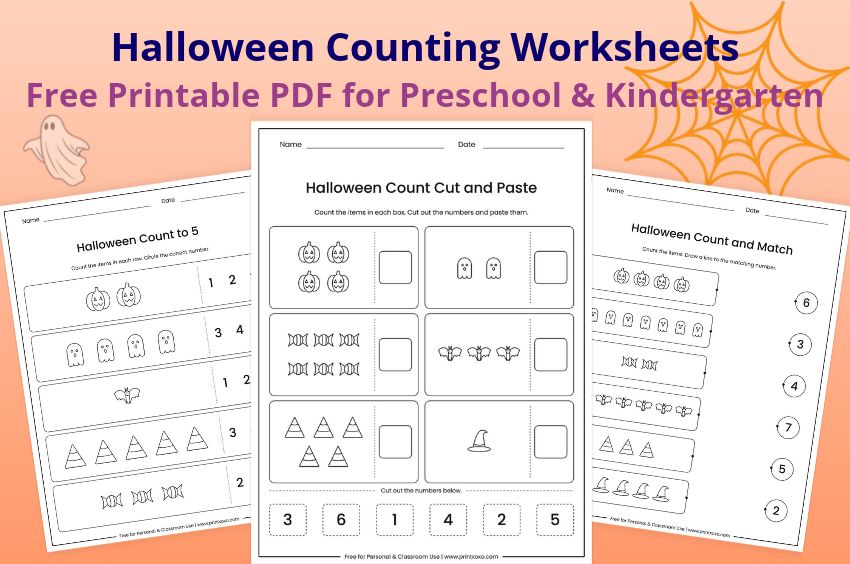
Counting looks simple until a four-year-old taps five pumpkins, announces “six,” and looks at you like you’re the one who got it wrong. That gap between reciting numbers and actually counting things is what these Halloween counting worksheets are for. Below are nine free printable PDFs, from a gentle count-to-5 page for preschoolers to a scattered I Spy page for older kids, each in US Letter and A4, in black and white with light outlines so your printer won’t be gulping ink.
Download the free Halloween counting worksheets
Tap the button under each worksheet to download or print the PDF in your paper size.
Halloween Count to 5 Worksheet
Halloween Count and Circle Worksheet
Halloween Count and Write Worksheet
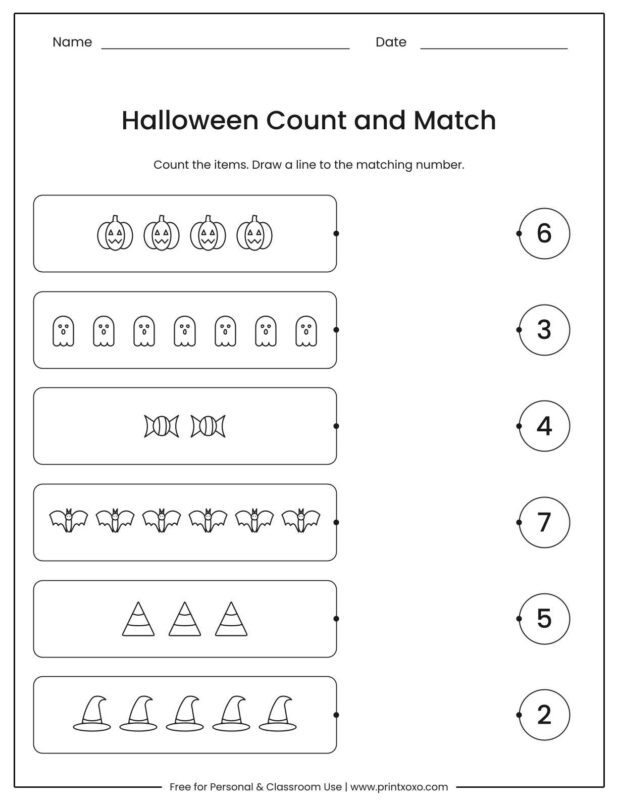
Halloween Count and Match Worksheet
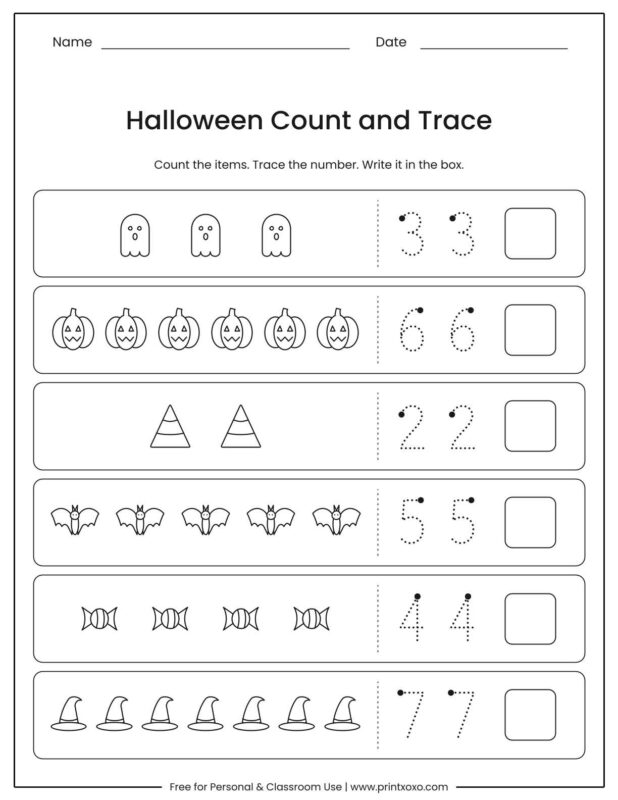
Halloween Count and Trace Worksheet
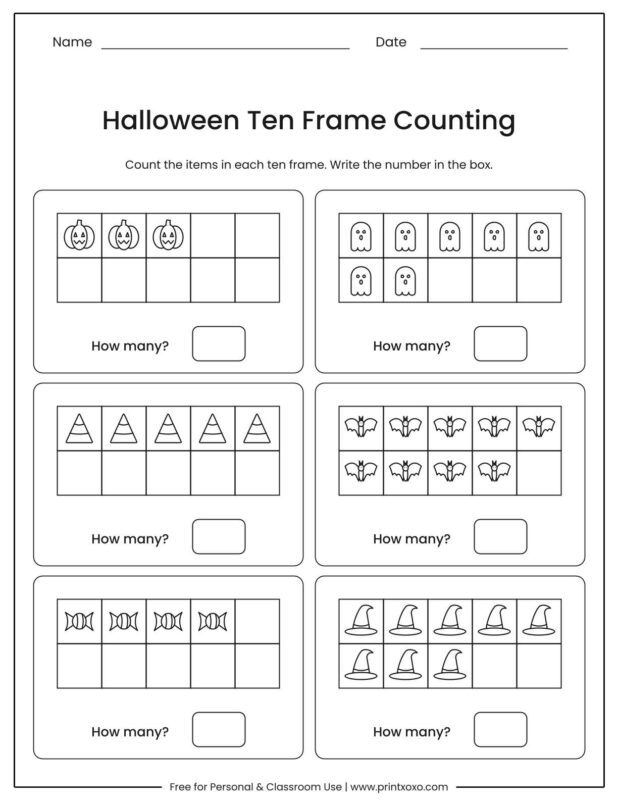
Halloween Ten Frame Counting Worksheet
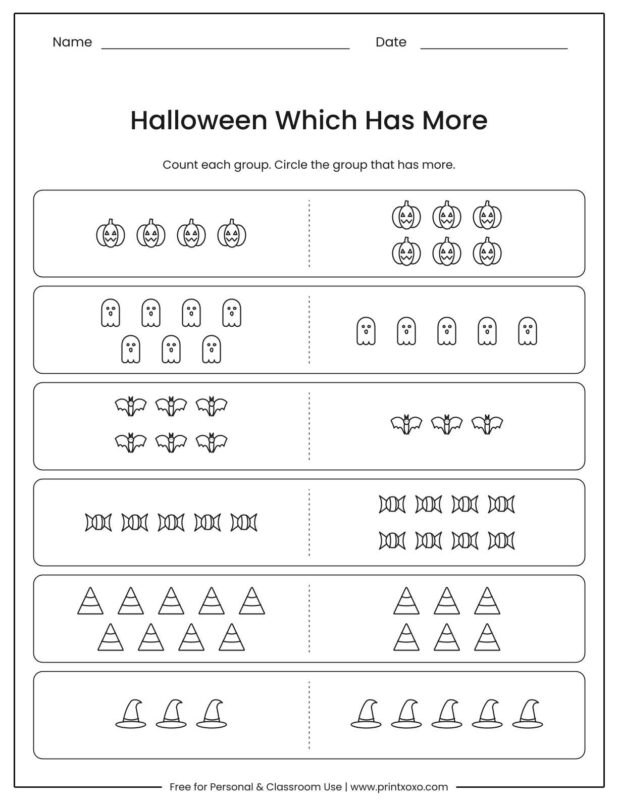
Halloween Which Has More Worksheet
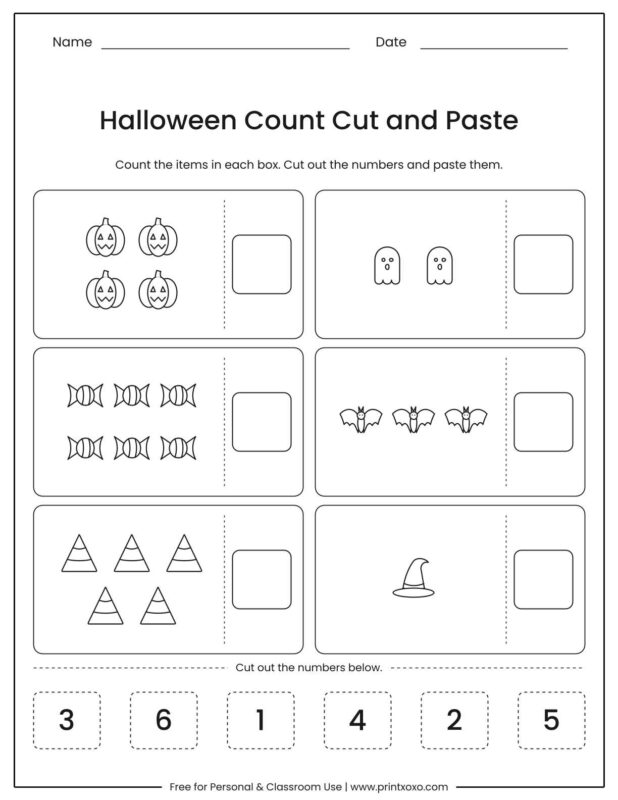
Halloween Count Cut and Paste Worksheet
Halloween I Spy Counting Worksheet

Use them for quiet time at home, a math center, or the folder of “just in case” activities every teacher keeps. Print one, or print them all.
Which worksheet should you start with?
| Worksheet | Good for | What it practices |
|---|---|---|
| Count to 5 | Ages 3 to 4 | Counting 1 to 5, number recognition |
| Count and Circle | Pre-K, kindergarten | Counting up to 9, choosing the right number |
| Count and Match | Pre-K, kindergarten | Pairing groups with numbers, pencil control |
| Count and Trace | Pre-K, kindergarten | Number formation |
| Count and Write | Kindergarten | Writing numbers from memory |
| Ten Frame Counting | Kindergarten, grade 1 | Number sense, spotting groups quickly |
| Which Has More | Kindergarten | Comparing two groups |
| Count Cut and Paste | Pre-K, kindergarten | Counting plus scissor skills |
| I Spy Counting | Kindergarten, grade 1 | Counting scattered objects |
Ages are a rough guide, not a rule. A child who can count to 20 on the stairs might still lose track of a row of eight bats, and that’s completely normal. Start where counting feels comfortable and move up when they ask for something harder.
Start gentle: counting to 5
Count to 5: how to use it
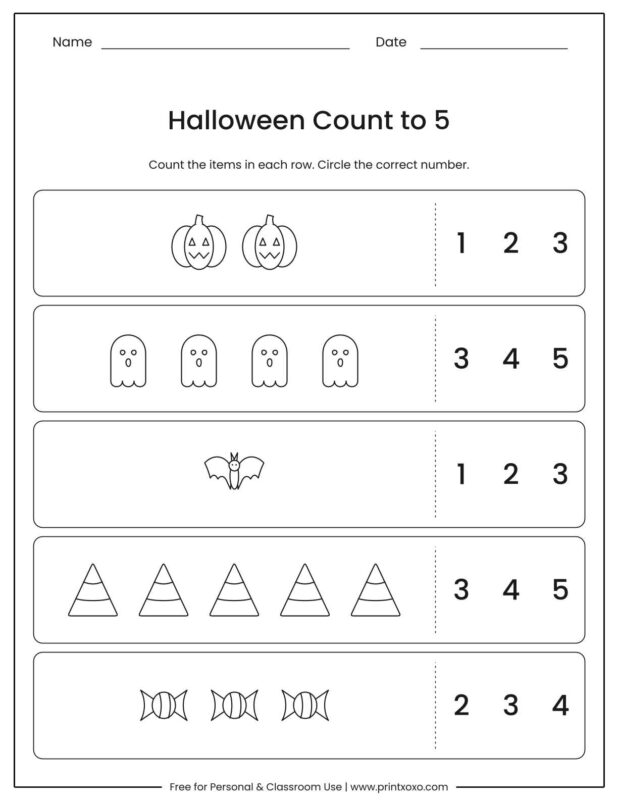
This is the softest landing in the set. Each row has big pumpkins, ghosts, a bat, candy corn, or candy, and your child circles the right number out of three. Nothing goes past five, and the pictures are large enough for little fingers to touch one at a time.
Try it this way: ask your child to tap each picture while saying the numbers out loud, then ask, “So how many are there?” If they start over from one instead of answering, don’t worry. Realizing that the last number you say is the total is a big idea, and it often clicks a little later than the counting itself.
Counting to 10 without writing: circle it or match it
These two pages ask for the same counting but let kids show the answer without a pencil full of numbers. Circling needs number recognition. Matching needs a line across the page. Both keep the focus on the counting itself.
Count and Circle: why the choices are neighbors
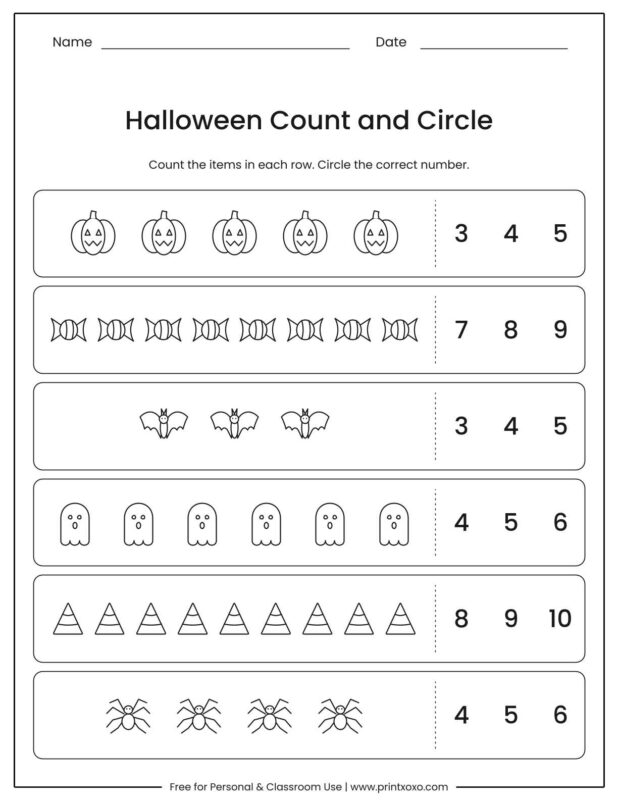
Counts run from 3 to 9 across rows of pumpkins, candy, bats, ghosts, candy corn, and spiders. The three answer choices are always neighbors (7, 8, and 9, for example), so a lucky guess won’t get far and kids really have to count. We spaced the candy and spiders out a little more so the pictures don’t run together.
Count and Match: line practice
Six groups on the left, six numbers on the right, mixed up on purpose. Kids count each group (anywhere from 2 to 7 items) and draw a line across the page to the matching number. A long, steady line is good pencil-control practice, too. If the lines start tangling, hand over a different color for each row.
Practice writing numbers: trace first, then write
Count and Trace: one dotted path
Each number is a single dotted line with a solid dot where every stroke begins, so your child follows one clear path instead of working around a hollow outline. They trace the number twice, then write it once on their own in the box. The rows go from 2 up to 7 items. Only the 4 takes two strokes, so point out both starting dots before they begin.
Count and Write: handling backward numbers
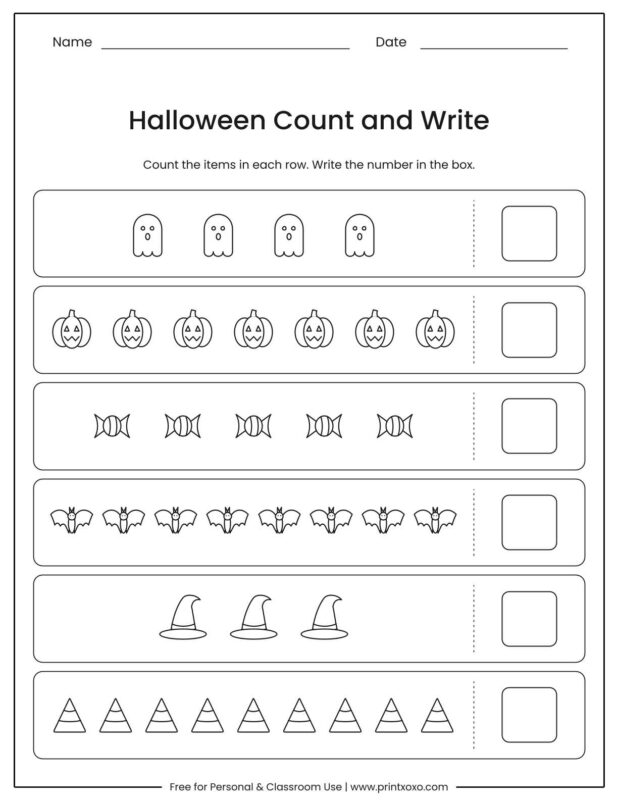
Here the answer box is empty, so your child has to write the number from memory. Counts range from 3 to 9. Numbers like 2, 3, 5, and 7 often come out backward at this age, which is very common in early writing. A quick “which way does the 5 face?” works better than erasing the whole thing.
Number sense: ten frames and “which has more?”
Ten Frames: seeing 5 and 2 more
Six ten frames, each partly filled with Halloween items (between 3 and 9 of them). Instead of counting one by one, kids can notice that a full top row is 5, so 7 is “5 and 2 more.” That kind of thinking makes addition easier later, which is why teachers lean on ten frames so much.
After your child writes the number, ask, “How did you figure it out?” Some kids count every single item. Others spot the full row of five right away. Both answers are worth hearing.
Which Has More: going one step further
Each row shows two groups of the same item, and your child circles the bigger group. The groups differ by two or three, and they’re arranged differently on each side, so simply picking the longer row won’t always work. Once they’ve chosen, ask, “How many more?” and let them count the difference out loud.
Hands-on and scattered: cut, paste, and spy
Cut and Paste: do a dry run first
Six boxes hold 1 to 6 items, and a strip of number tiles at the bottom waits to be cut out and pasted into the square beside each box. Preschoolers often need a hand with the scissors, so consider pre-cutting the tiles and letting them focus on counting.
Do a dry run first: lay each tile in its square, check the counts, and only then glue. Glue is a lot harder to undo than pencil.
I Spy: tracking what you’ve counted
One big picture, with pumpkins, ghosts, bats, candy, and candy corn scattered and tilted every which way. A key at the bottom tells kids what to count, and each item has a box for the total.
Counting scattered things is harder than counting a tidy row, because you have to remember what you’ve already counted. No single item goes above eight, which fits what kindergarten standards expect for scattered counting (up to 10). Suggest making a small pencil mark on each picture as it’s counted, or counting one kind at a time.
Small habits that make counting stick
A worksheet works best when it’s one piece of a bigger counting routine. A few things are worth building in:
- Touch every item. Pointing, tapping, or sliding a pencil along each picture helps kids say one number for one object, so they don’t skip or double-count.
- Ask “how many?” at the end. After counting, ask for the total. Kids who can answer with the last number they said are learning that the final count tells the whole amount.
- Keep it short. One or two pages is plenty. A child who stops while counting still feels fun is more likely to ask for another page tomorrow.
- Count real things too. Buttons, pumpkin seeds, or mini erasers on the kitchen table make the same skill feel physical. Stay close with small objects, especially around children under three.
- Praise the effort, not just the answer. “I like how carefully you counted those bats” goes further than “correct.”
How these fit with kindergarten math standards
If you’re in the US, you may like to know where these pages sit. In Common Core terms, counting a group to answer “how many?” is K.CC.B.5 (up to 20 objects in a line, array, or circle, and up to 10 when scattered), writing numbers is K.CC.A.3, and comparing groups is K.CC.C.6. Not every state uses Common Core, and these worksheets aren’t a full curriculum, so treat this as a rough guide rather than an official alignment.
Printing tips
- Pick the right paper size. Use the US Letter files for 8.5 x 11 inch paper (US and Canada) and the A4 files for A4 paper.
- Print at 100% or “actual size.” Fit-to-page settings can shrink the layout or clip the border.
- Black and white is fine. The outlines are light, so draft or economy mode works well.
- Reuse the pages. Slip a worksheet into a clear sheet protector and use a dry-erase marker. (Skip this for the cut-and-paste page, of course.)
Frequently asked questions
What age are these Halloween counting worksheets for?
They’re made for preschool through early kindergarten. The ten frame and I Spy pages stretch into first grade for kids who need a little more challenge.
Are the worksheets really free?
Yes. Each page is free for personal and classroom use, as noted in the footer.
Should I download the US Letter or A4 version?
Choose the one that matches your printer paper. US Letter is the standard in the US and Canada. A4 is the standard in most other countries.
Will these use a lot of ink?
Not much. Everything is drawn in thin outlines with no filled-in shapes, and the titles aren’t bold.
How high should a kindergartner be counting?
Common Core asks kindergartners to count up to 20 objects in a line, array, or circle, and up to 10 when the objects are scattered. Many younger children are still working on counting reliably to 5 or 10, which is exactly where these pages start.
My child keeps skipping items or counting one twice. Is that normal?
Yes, it’s very common. Have them touch each item as they say its number, or make a small pencil mark on every picture they’ve counted.