

Blog
Free Halloween Addition and Subtraction Worksheets for Kindergarten and First Grade

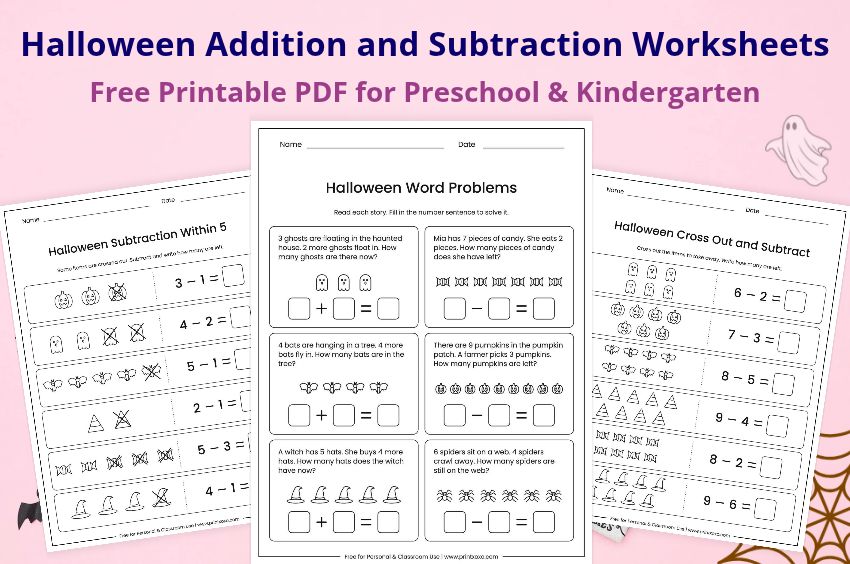
Math facts don’t get easier just because there’s a pumpkin on the page, but they do get a lot less painful. These free Halloween addition and subtraction worksheets give kindergarten and first-grade kids eleven different ways to practice adding and taking away within 10, from counting pumpkins and ghosts to solving short Halloween stories. Each one comes in US Letter and A4, prints in black and white, and uses thin outlines so it won’t drain your ink.
Download the free Halloween addition and subtraction worksheets
The worksheets go from easiest to hardest, with the mixed practice at the end. Tap the button under each one to download the PDF in your paper size.
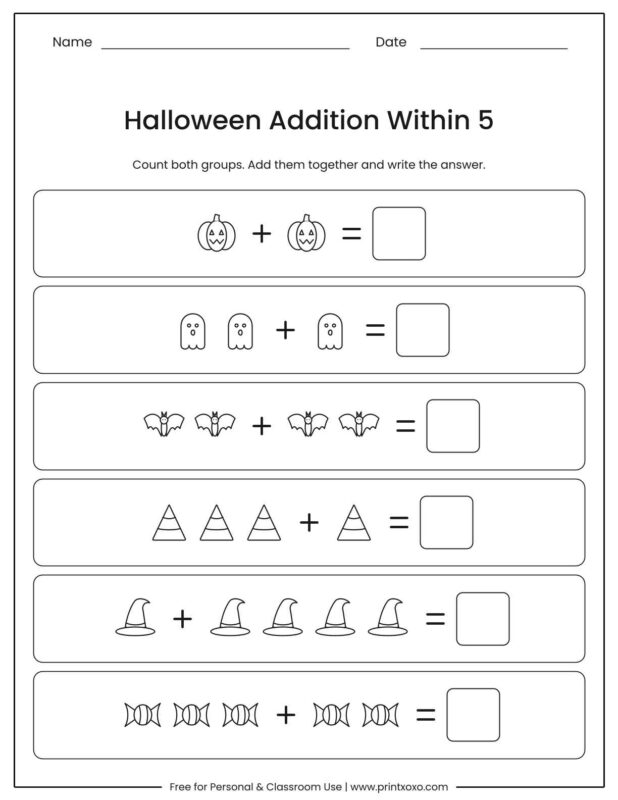
Halloween Addition Within 5 Worksheet
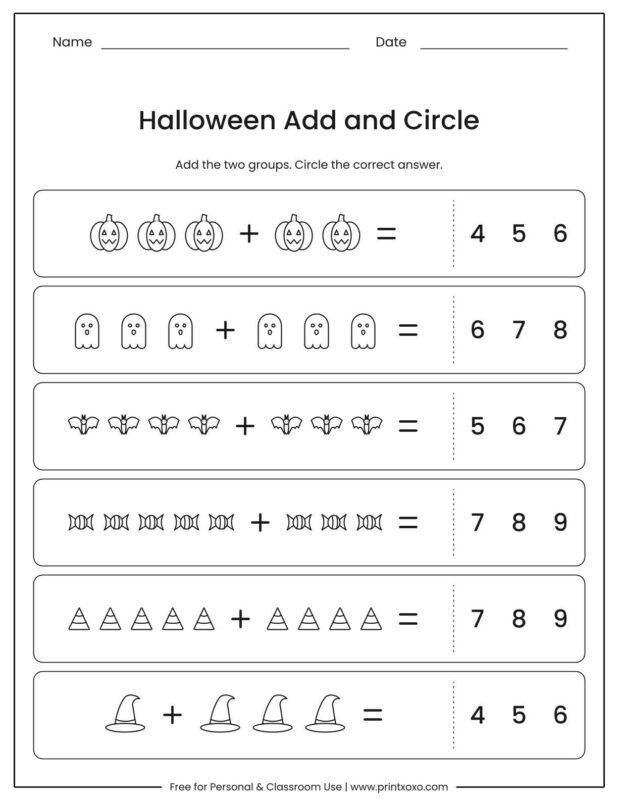
Halloween Add and Circle Worksheet
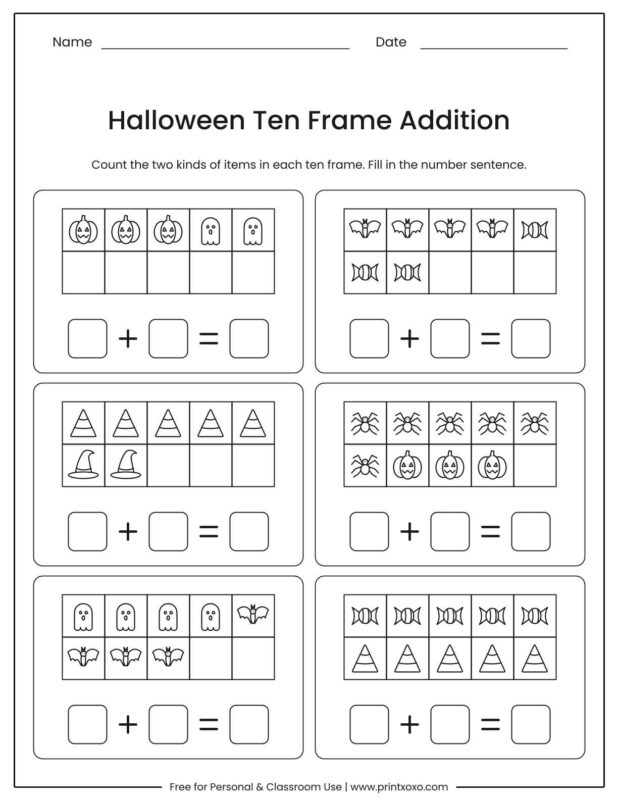
Halloween Ten Frame Addition Worksheet
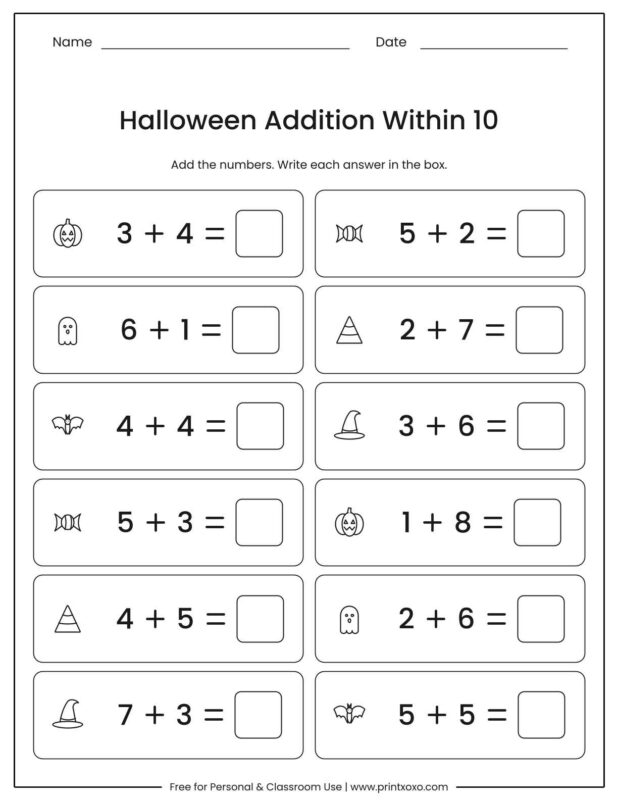
Halloween Addition Within 10 Worksheet
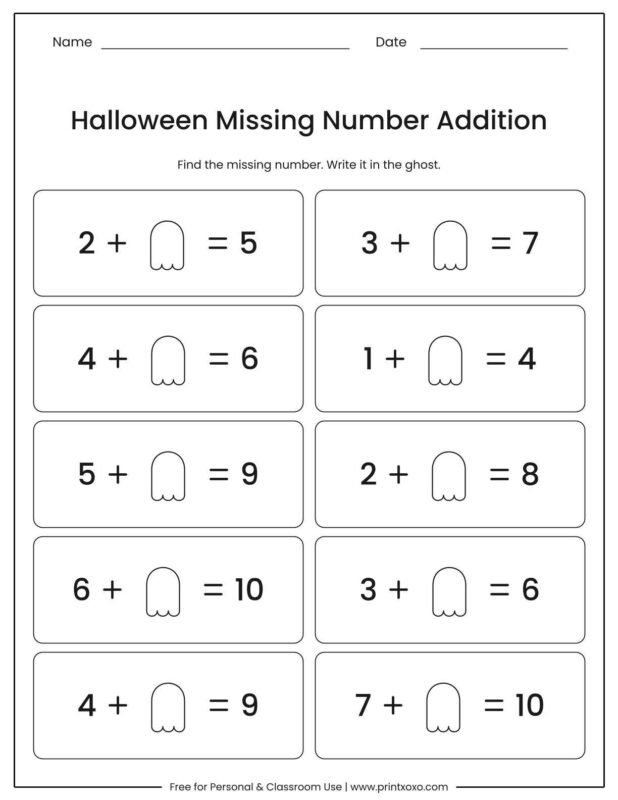
Halloween Missing Number Addition Worksheet
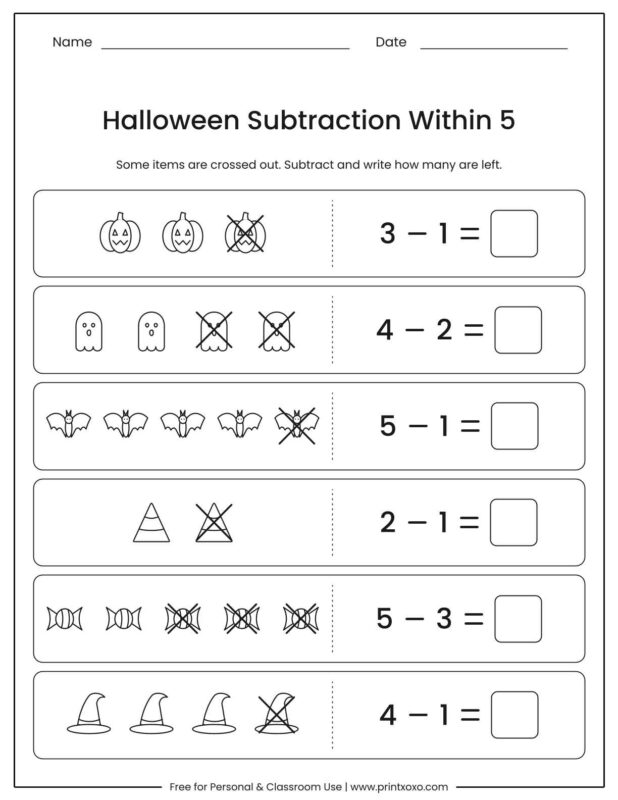
Halloween Subtraction Within 5 Worksheet
Halloween Cross Out and Subtract Worksheet

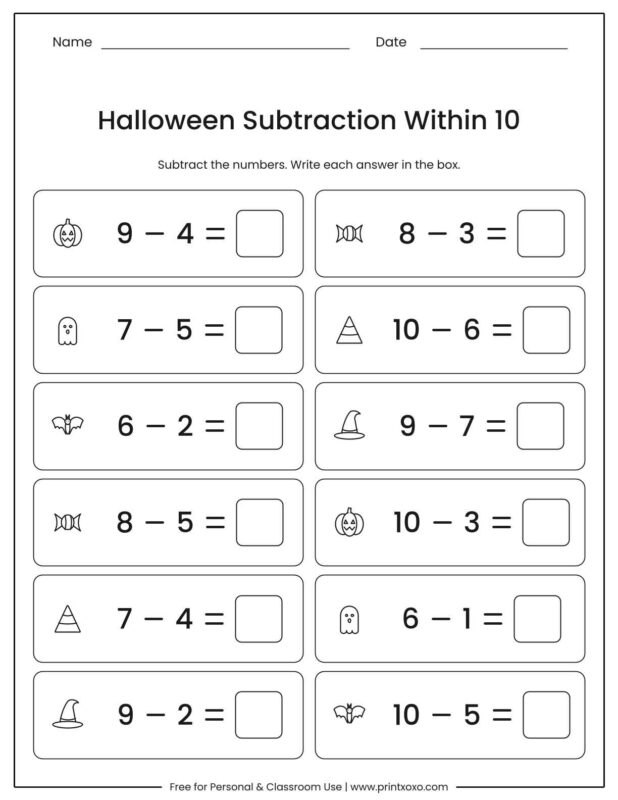
Halloween Subtraction Within 10 Worksheet
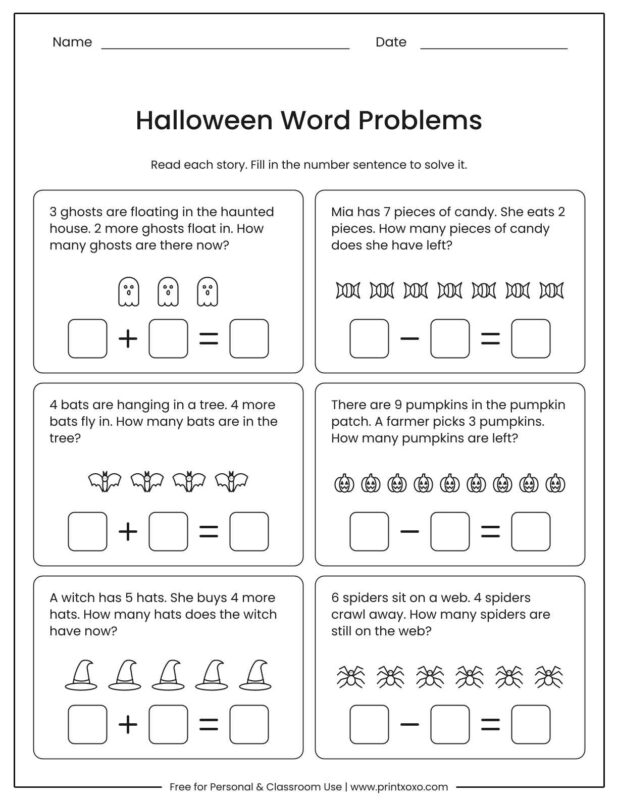
Halloween Word Problems Worksheet
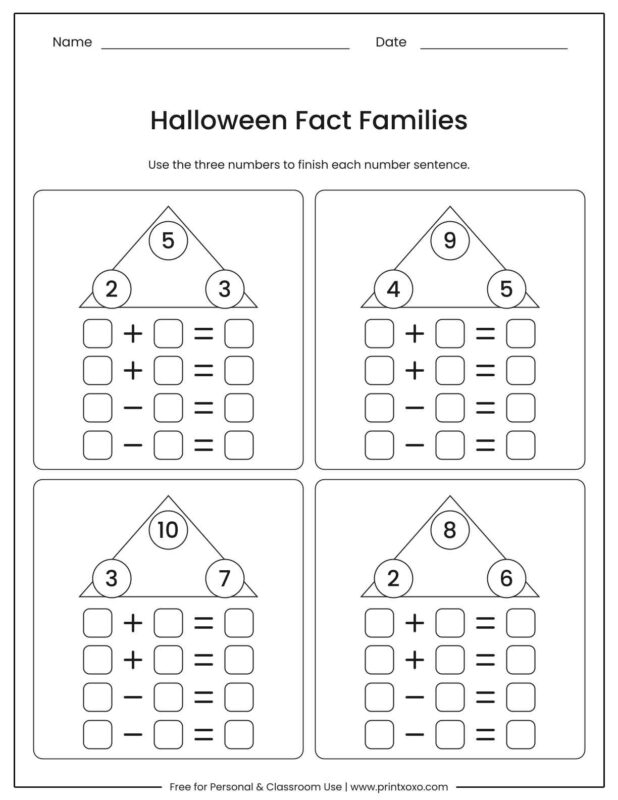
Halloween Fact Families Worksheet
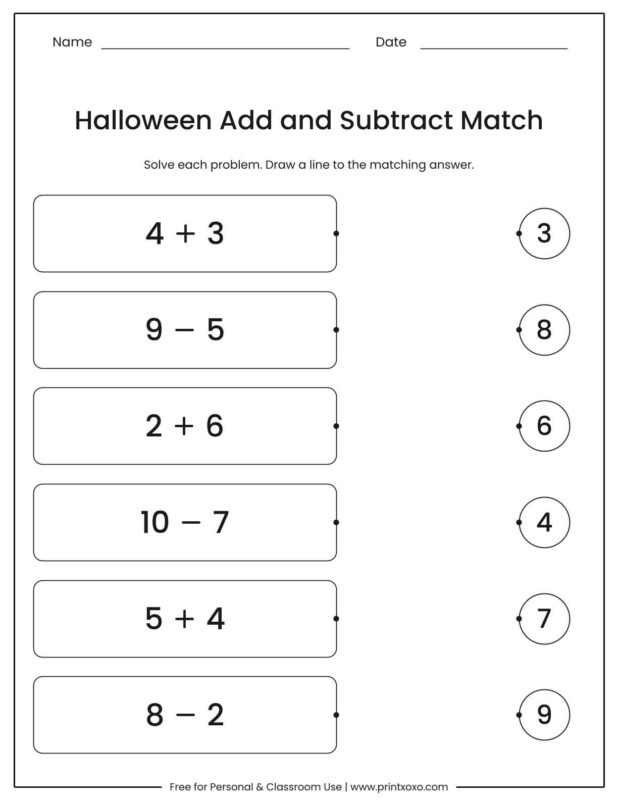
Halloween Add and Subtract Match Worksheet
Where to start
Every child gets to adding and subtracting at a different speed, so here’s a simple way to choose:
- Still counting everything one by one (around ages 4 to 5): Begin with Addition Within 5, Subtraction Within 5, and Add and Circle. They use pictures, so kids can count their way to the answer.
- Kindergarten: Move on to Ten Frame Addition, Cross Out and Subtract, and the two Within 10 pages.
- First grade: Try Missing Number Addition, Word Problems, Fact Families, and Add and Subtract Match.
Not ready to add yet? Our Halloween counting worksheets are a gentler place to begin.
What each worksheet practices
Picture addition: from counting all to counting on
Addition Within 5 and Add and Circle show two small groups of the same Halloween item, and your child finds the total. At first they’ll probably count every picture from one, and that’s fine. Over time, nudge them to say the first group’s total out loud and count on from there: “three pumpkins… then 4, 5.” In Add and Circle, the three answer choices are always side by side (like 7, 8, and 9), so guessing doesn’t get far and counting does.
Ten frames: see the five first
Each frame in Ten Frame Addition holds two kinds of Halloween items, such as pumpkins and ghosts, and your child writes both numbers plus the total. The sums run from 5 to 10. A full top row is five, so 4 and 3 becomes “5 and 2 more.” Ask your child whether they noticed the full row or counted every box.
Number sentences within 10
Addition Within 10 and Subtraction Within 10 are the plain practice pages: twelve problems each, with a tiny Halloween picture beside every one. First-grade standards ask kids to be fluent with addition and subtraction within 10, which means quick and accurate without a lot of finger counting. Three or four problems a day is a gentler way to build that speed than one big sitting. If you want practice that isn’t Halloween-themed, our addition worksheets for preschool and kindergarten cover the same ground year-round.
The ghost trick: missing numbers
In Missing Number Addition, the answer goes inside a ghost, as in 3 + □ = 7. This is the page that quietly teaches subtraction, because kids can find the missing number by counting up from 3 to 7 or by thinking 7 − 3. Let them pick their own method, then check it by adding the ghost’s number back. For more of this skill, see our missing number worksheets .
Taking away with a pencil
Subtraction Within 5 comes with some pictures already crossed out, so kids count what’s left. Cross Out and Subtract hands over the pencil: they cross out the items to take away, then count what remains. The thing to watch is counting the crossed-out items instead of the leftovers. A simple rule helps: the answer is whatever isn’t crossed out.
Stories and fact families
Word Problems has six short Halloween stories, three about adding and three about taking away, and every number is 9 or less. Read each one aloud, then ask, “Is something joining the group, or leaving it?” Younger kids can draw the story first. Fact Families shows three numbers in a triangle and asks for two addition sentences and two subtraction sentences. It’s a good way to show that 3 + 4 = 7 and 7 − 4 = 3 are really the same story told two ways.
Mixed practice with a match
Add and Subtract Match puts plus and minus problems on the left and the answers on the right in a different order. Before solving, ask your child to point to the sign and say it out loud. That one habit fixes the most common mistake in this set.
Common mix-ups and quick fixes
- Adding when the sign says minus (or the other way around). Have your child say the problem in words: “seven take away three.”
- Counting the first group all over again. Teach counting on: start from the bigger group’s number instead of from one.
- Writing the first number as the answer. Ask, “Should the answer be bigger or smaller than where we started?” Adding makes it bigger. Taking away makes it smaller.
- Skipping the equals sign. Remind them that = means “is the same as,” so both sides have to match.
Easy Halloween math games with no printer
- Under the cup: Put 8 mini pumpkins or buttons on the table, cover some with a cup while your child watches, and ask how many are hiding. It’s the same thinking as the ghost pages.
- Trick-or-treat bag: Start with 9 pom-poms as pretend candy. “Visit houses” where you add or take away a few, and ask how many are in the bag each time.
- Roll and add: Roll two dice and add them. Sums go up to 12, so stick to rolls that total 10 or less to match these worksheets.
Keep small objects away from children under three, and stay close when little ones play with them.
How these fit with US math standards
In Common Core terms, representing addition and subtraction with objects, drawings, and equations is K.OA.A.1, and fluently adding and subtracting within 5 is K.OA.A.5. In first grade, fluency within 10 is part of 1.OA.C.6, understanding subtraction as an unknown-addend problem is 1.OA.B.4, and finding the unknown number in an equation is 1.OA.D.8. Not every state uses Common Core, and these worksheets aren’t a full curriculum, so treat this as a rough guide rather than an official alignment.
Printing tips
- Match the paper. Use the US Letter files for 8.5 x 11 inch paper (US and Canada) and the A4 files for A4 paper.
- Print at 100% or “actual size.” Fit-to-page settings can shrink the layout or clip the border.
- Go easy on ink. The pages are thin outlines only, so draft or economy mode works fine.
- Reuse pages. Slip a worksheet into a clear sheet protector and use a dry-erase marker. Our guide to printing PDF worksheets has more tips.
Frequently asked questions
What grade are these Halloween addition and subtraction worksheets for? They’re made for kindergarten and first grade. The picture-based pages within 5 also work for older preschoolers who are ready to try.
Do the worksheets go beyond 10? No. Every problem stays within 10 on purpose, so kids can build fluency with the basic facts first.
Do the kids have to color anything? No. The pages are plain black-and-white line art, and nothing needs coloring to complete a worksheet.
Are they free for classroom use? Yes. Each page is free for personal and classroom use, as noted in the footer.
Should I choose US Letter or A4? Pick whichever matches your printer paper. US Letter is standard in the US and Canada, and A4 is standard in most other countries.