

Blog
Land, Water and Air Animals Worksheets | Free Printable Activities for Kids

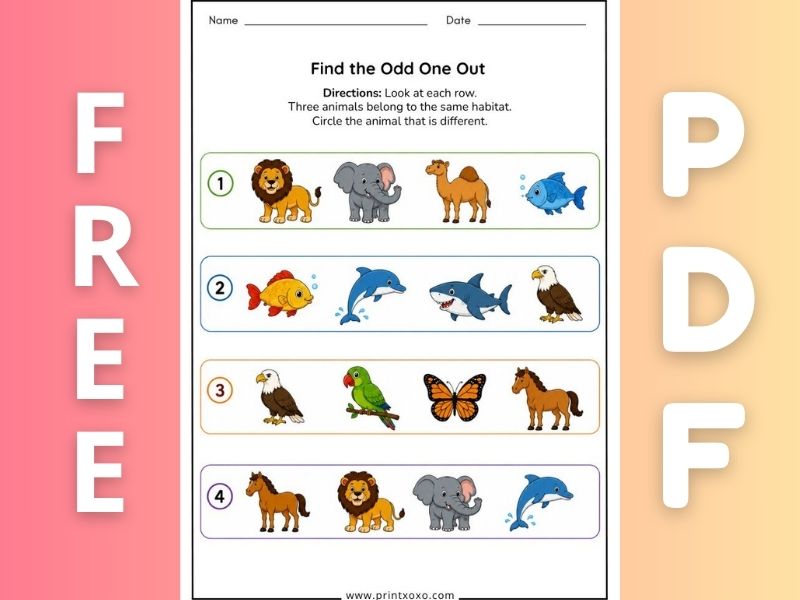
Young children are naturally curious about animals. They enjoy watching birds fly across the sky, spotting fish in an aquarium, and learning about animals they see in books, cartoons, and everyday life. As children begin exploring the world around them, one of the early science concepts they learn is that different animals live in different places.
Some animals spend their lives on land, some live in water, and others move through the air. Understanding these habitats helps children organize information, build observation skills, and develop a stronger foundation for future science learning.
These free printable Land, Water and Air Animals Worksheets are designed for preschool and kindergarten learners. Through simple activities like matching, counting, sorting, and identifying, children can learn about animal habitats in a fun and hands-on way.
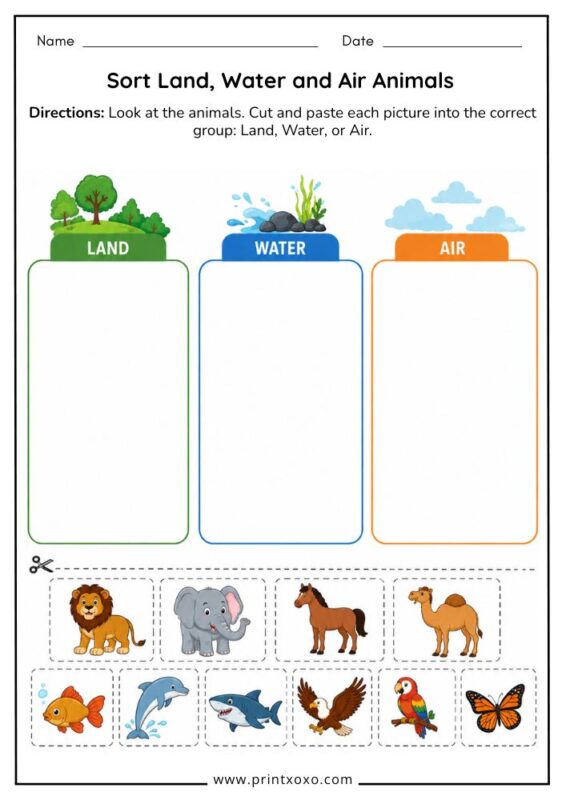
Cut and paste each animal into the correct habitat group. This hands-on activity helps children understand where different animals live.
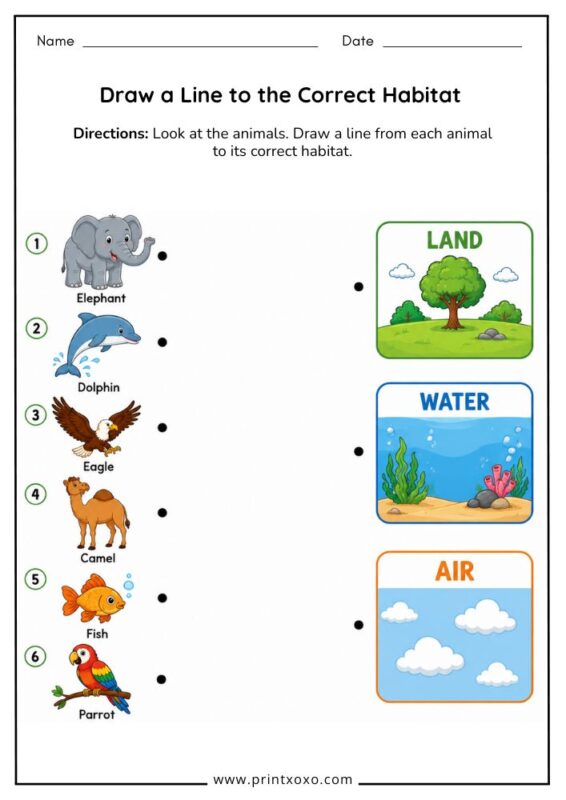
Look at each animal and draw a line to the correct habitat. This worksheet helps children build early science and observation skills.
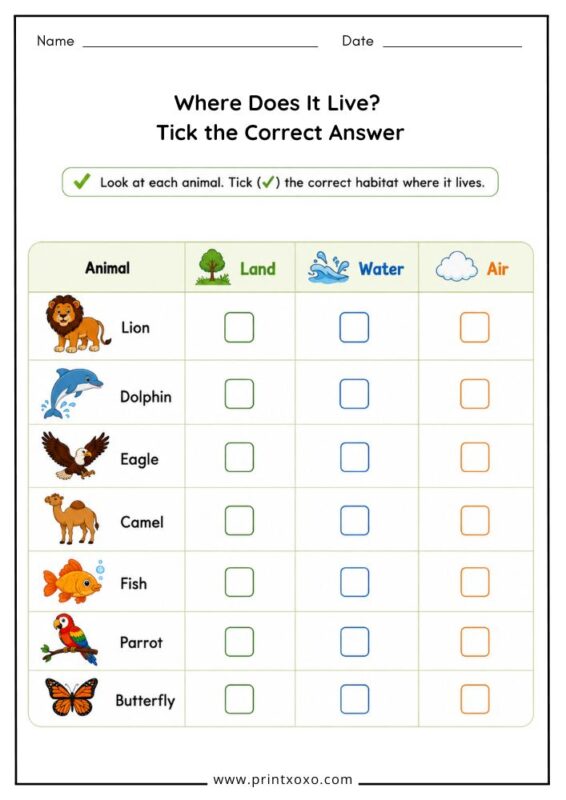
Choose the correct habitat for each animal. Children learn to classify animals as land, water, or air animals.
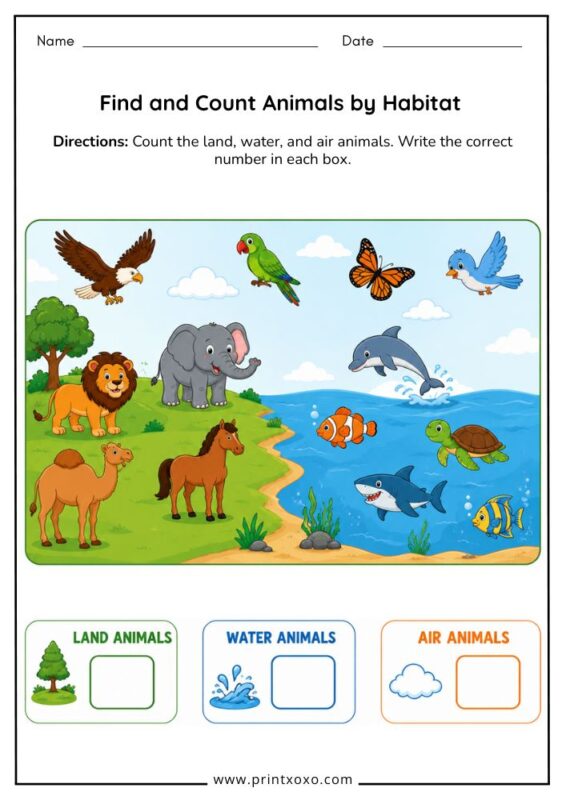
Count the land, water, and air animals in the picture. This worksheet combines science and early counting practice.
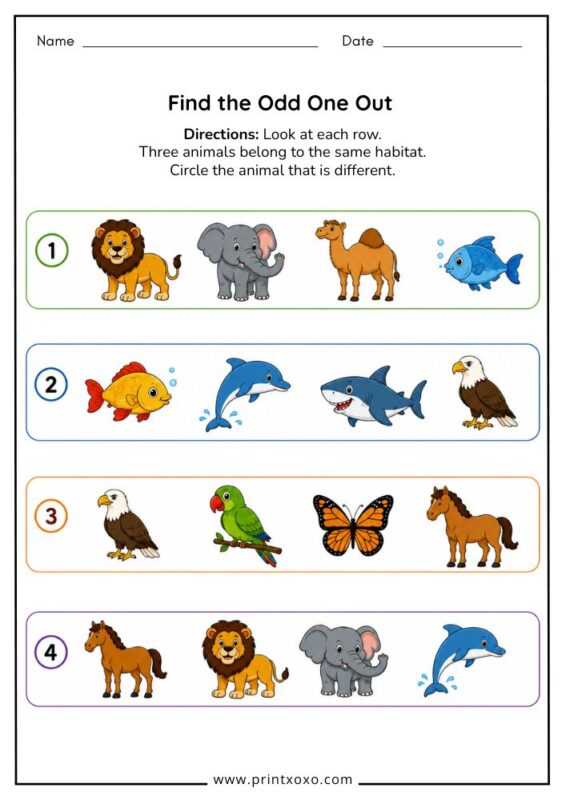
Look at each row and find the animal that is different. This activity builds observation and classification skills.
What Are Land, Water, and Air Animals?
Animals can be grouped according to where they live.
Land Animals
Land animals spend most of their lives on land. They walk, run, or crawl and depend on land for food and shelter.
Common examples include:
- Lion
- Elephant
- Horse
- Camel
- Rabbit
- Cow
Water Animals
Water animals live in oceans, rivers, lakes, or ponds. They are adapted to survive and move in water.
Examples include:
- Fish
- Dolphin
- Shark
- Whale
- Octopus
- Seahorse
Air Animals
Air animals are creatures that fly or spend much of their time in the air.
Examples include:
- Eagle
- Parrot
- Owl
- Butterfly
- Bee
- Sparrow
Learning these groups helps children understand how animals live and why habitats are important.
Why Should Children Learn About Animal Habitats?
Before children study ecosystems and food chains, they first learn how to classify and compare living things. Animal habitat activities encourage children to observe pictures, identify similarities, and sort information into categories.
These skills help children:
- Build observation skills
- Improve classification skills
- Strengthen logical thinking
- Expand vocabulary
- Develop early science knowledge
- Practice visual discrimination
- Build confidence through independent learning
Simple activities often create meaningful learning experiences. Asking questions such as “Where does a dolphin live?” or “Can an eagle live in water?” encourages children to think and make connections.
Land, Water and Air Animals Worksheets Included in This Pack
This collection includes five printable activities designed to help children recognize and classify animals according to their habitats.
1. Cut and Paste Land, Water and Air Animals
This hands-on activity introduces the concept of animal habitats in an interactive way.
Children cut out the pictures and paste each animal into the correct group. Activities like this strengthen fine motor skills while helping children understand where animals live.
2. Draw a Line to the Correct Habitat
In this worksheet, children connect each animal to its correct habitat.
This activity encourages observation and helps reinforce the differences between land, water, and air animals.
3. Where Does It Live? Tick the Correct Answer
This worksheet gives children an opportunity to think independently.
Children look at each animal and tick the correct habitat. It provides simple practice and helps reinforce what they have learned.
4. Find and Count Animals by Habitat
This worksheet combines early math skills with science learning.
Children carefully look at the pictures, count the animals in each habitat, and write the correct numbers in the boxes. Activities like this encourage children to pay attention to details while practicing counting skills.
5. Find the Odd One Out
Critical thinking begins with simple comparisons.
In this activity, children look at each row and identify the animal that does not belong to the same habitat group. The worksheet encourages observation and helps children apply what they have learned in a fun way.
Benefits of Using Land, Water and Air Animals Worksheets
Printable worksheets provide children with opportunities to practice and review concepts at their own pace. Because these activities use familiar animals and simple instructions, children can focus on understanding the concept instead of struggling with difficult tasks.
Some of the benefits include:
- Reinforces early science concepts
- Improves observation skills
- Strengthens classification abilities
- Encourages critical thinking
- Builds vocabulary
- Supports fine motor development
- Combines science and early math skills
- Creates opportunities for independent learning
These activities are especially helpful for visual learners because pictures make abstract ideas easier to understand.
Using These Worksheets in the Classroom
Teachers can use these worksheets during science lessons, morning work, small-group activities, learning centers, or independent practice.
One simple sequence might be:
- Start with the Cut and Paste activity.
- Practice matching with Draw a Line to the Correct Habitat.
- Reinforce learning with Tick the Correct Answer.
- Add counting practice with Find and Count Animals by Habitat.
- Finish with Find the Odd One Out as a review activity.
This gradual approach helps children build confidence while learning new concepts.
Using These Worksheets at Home
Parents can make these activities even more meaningful by connecting them to everyday experiences.
For example, while reading books or watching nature videos, ask questions such as:
- Which animals live on land?
- Can a fish live in the air?
- Where does a dolphin live?
- Which birds can fly?
Simple conversations help children connect worksheet practice with the real world.
Frequently Asked Questions
What are land animals?
Land animals spend most of their lives on land. Examples include lions, elephants, horses, camels, and rabbits.
What are water animals?
Water animals live in oceans, rivers, lakes, and ponds. Fish, dolphins, sharks, and whales are examples of water animals.
What are air animals?
Air animals are creatures that fly or spend much of their time in the air. Common examples include eagles, parrots, owls, butterflies, and bees.
Are these worksheets suitable for preschoolers?
Yes. These worksheets are designed specifically for preschool and kindergarten learners. The activities use simple instructions and child-friendly illustrations.
Can teachers use these worksheets in classrooms?
Absolutely. Teachers can use them for science lessons, learning centers, homework, independent work, and review activities.
Conclusion
Learning about animal habitats is an important part of early science education. Understanding that different animals live on land, in water, or in the air helps children organize information and develop a better understanding of the natural world.
These free printable Land, Water and Air Animals Worksheets provide a fun and engaging way for preschool and kindergarten learners to explore animal habitats. Whether used in classrooms, homeschool settings, or at home, these activities encourage children to observe, compare, classify, and learn through hands-on practice.
Download the worksheets, print your favorites, and help young learners discover where animals live through fun and meaningful learning activities.