

Blog
Addition Worksheets for Preschool and Kindergarten – Free Printable

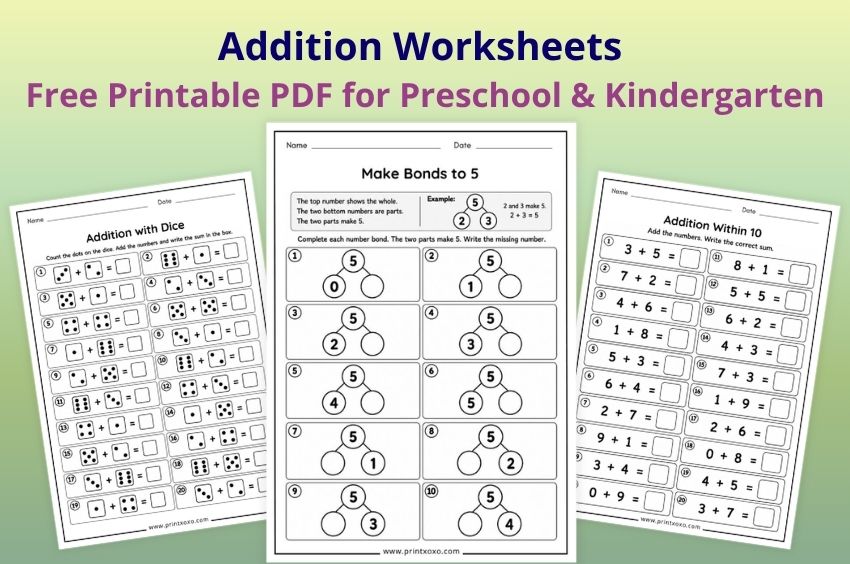
Addition is one of the first math skills children begin exploring when they learn that two groups can be put together to make a larger group. These free printable addition worksheets give preschool and kindergarten children simple ways to practice addition through pictures, counting, ten frames, number bonds, missing numbers, dice, and easy word problems.
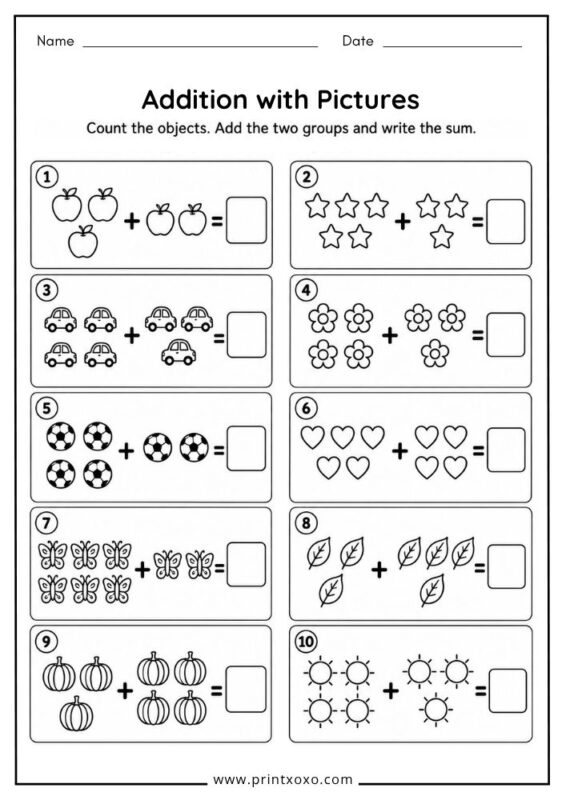
Count the two groups of pictures and add them together to find the total.
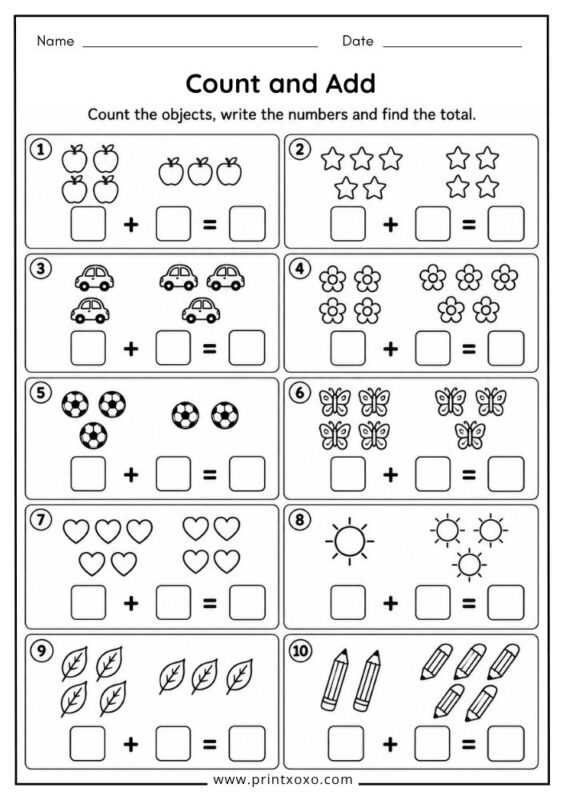
Count each group, write the numbers, and add them to find the total.
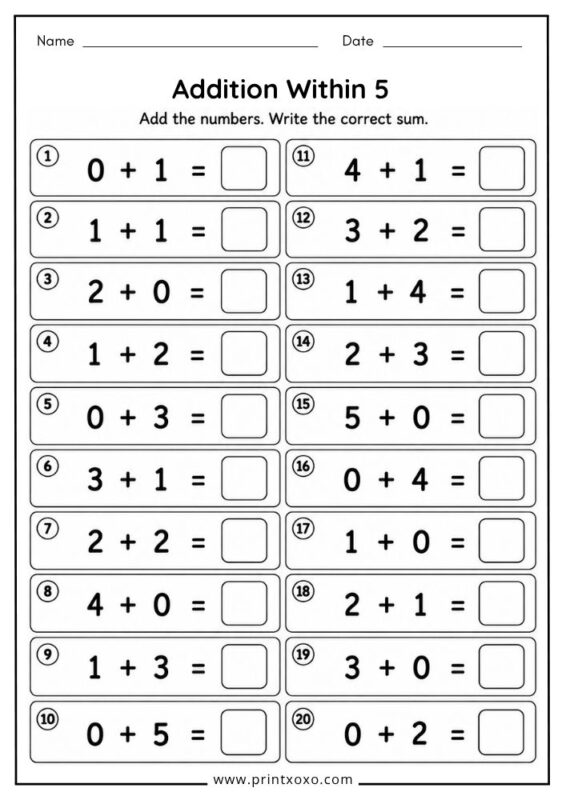
Solve each simple addition problem and write the answer.
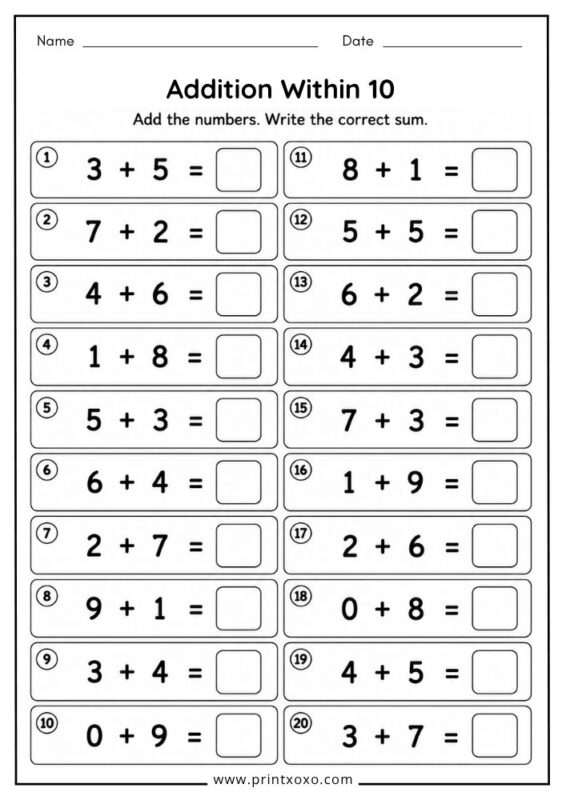
Solve each addition problem and write the sum.
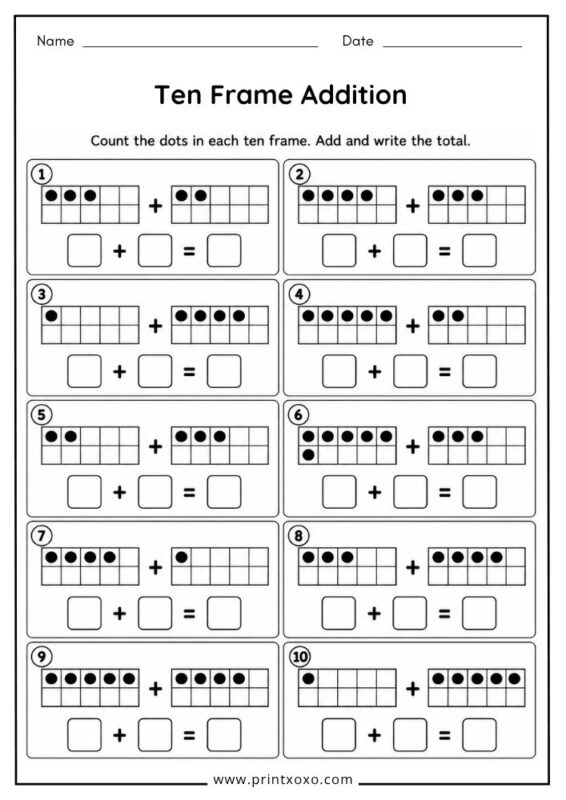
Count the ten frames, combine the groups, and find the sum.
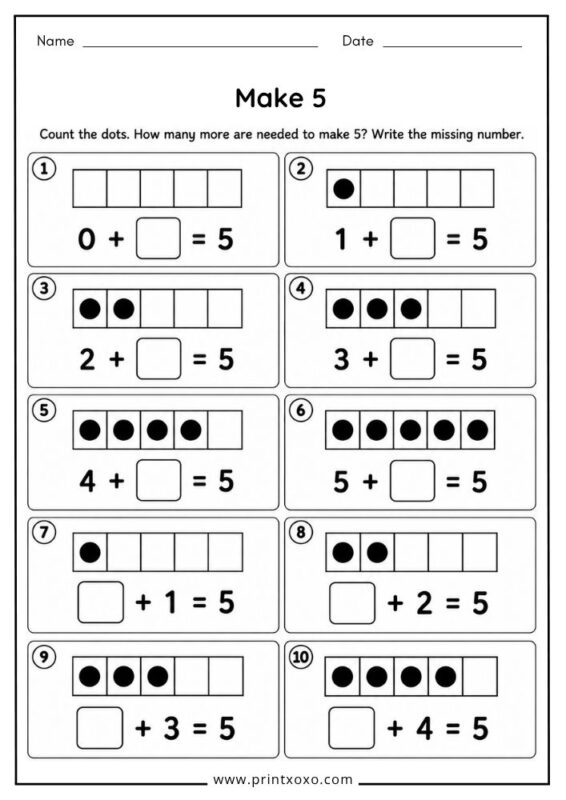
Find the missing number that makes 5.
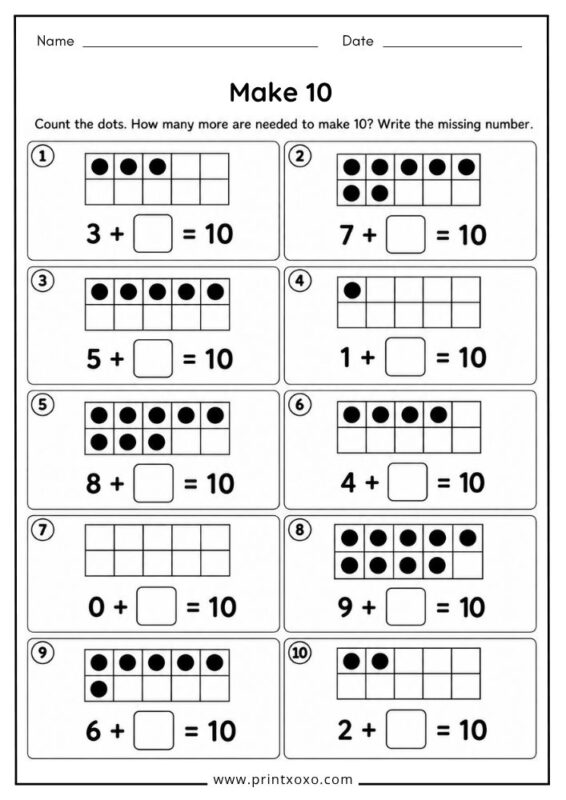
Find the missing number that makes 10.
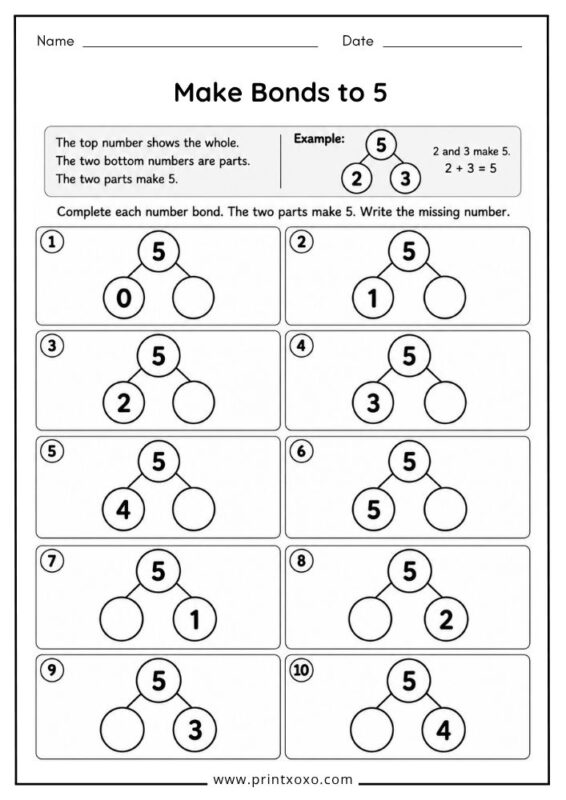
The two parts make 5. Write the missing number.
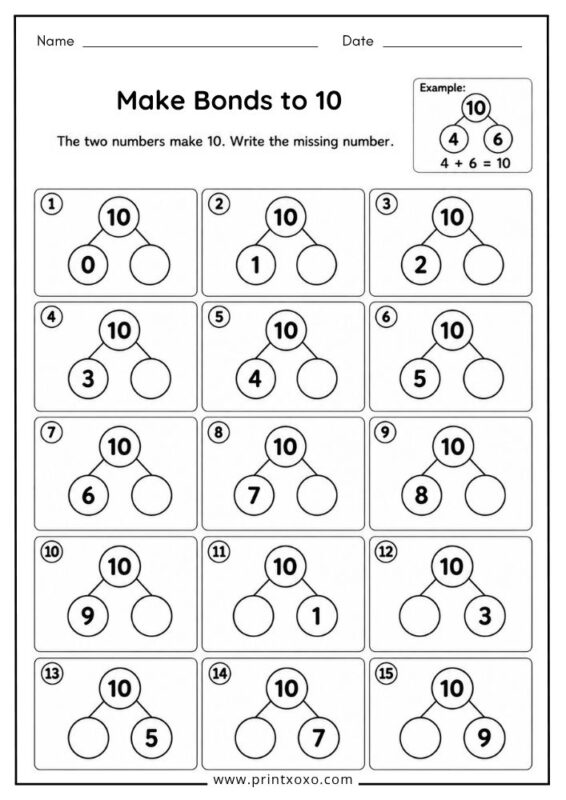
The two parts make 10. Write the missing number.
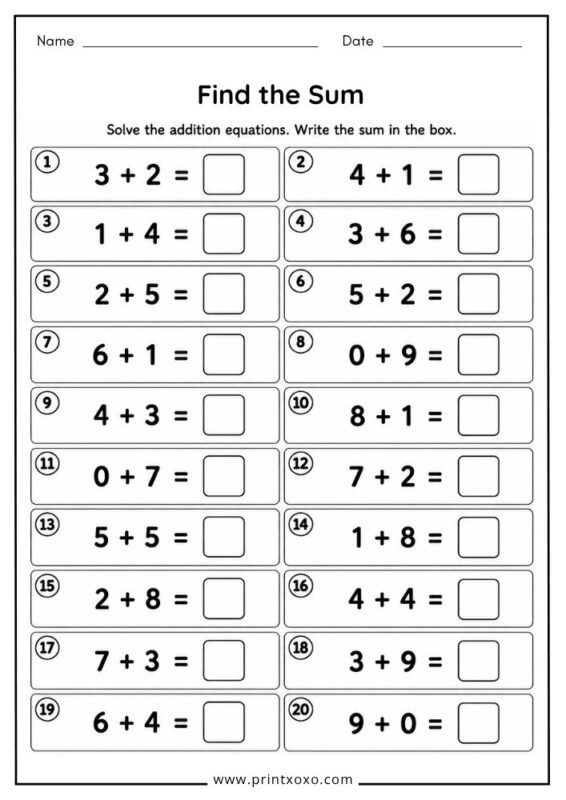
Solve each addition equation and write the sum.
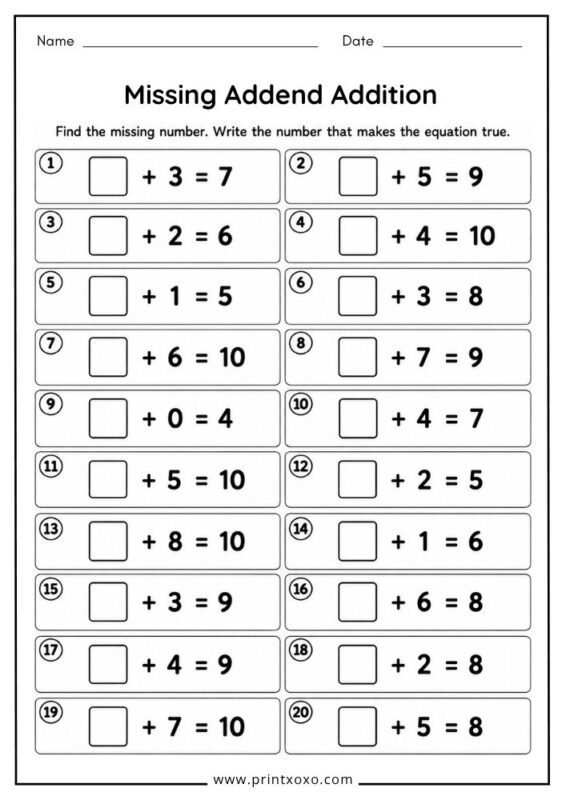
Find the missing number that makes the equation correct.
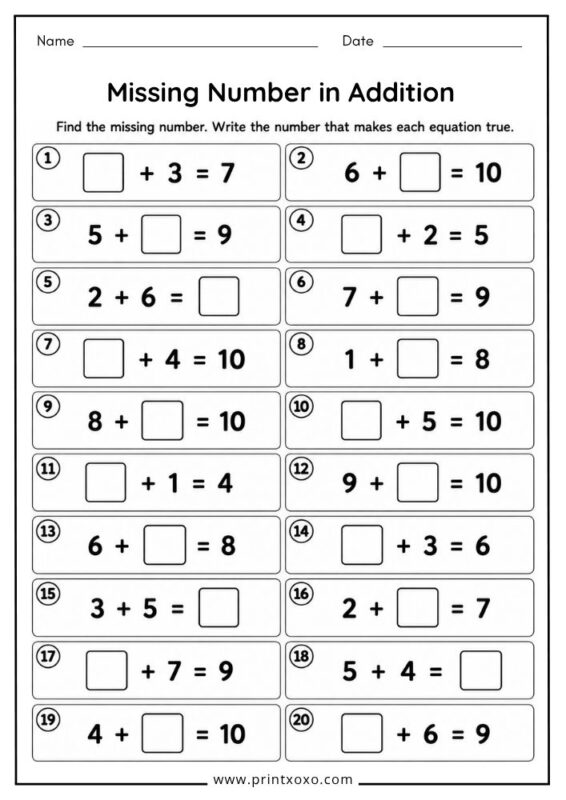
Find the missing number and complete each addition equation.
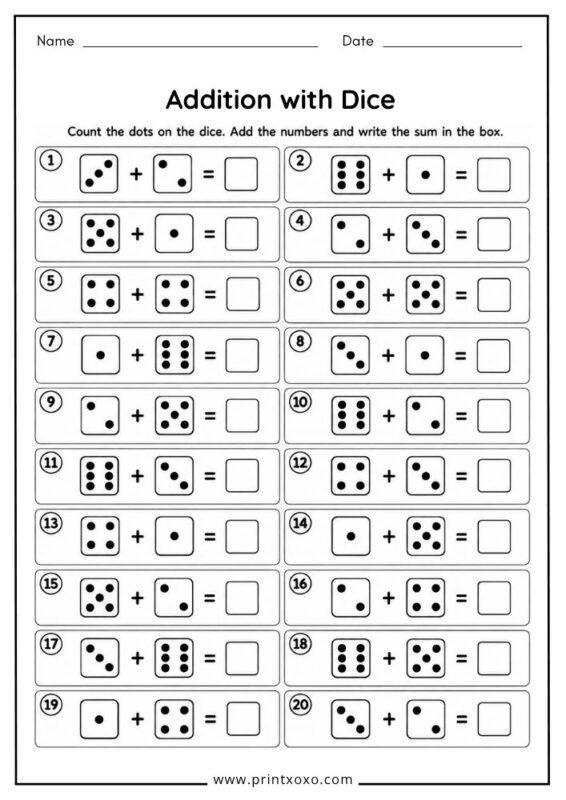
Count the dots on both dice and add the numbers together.
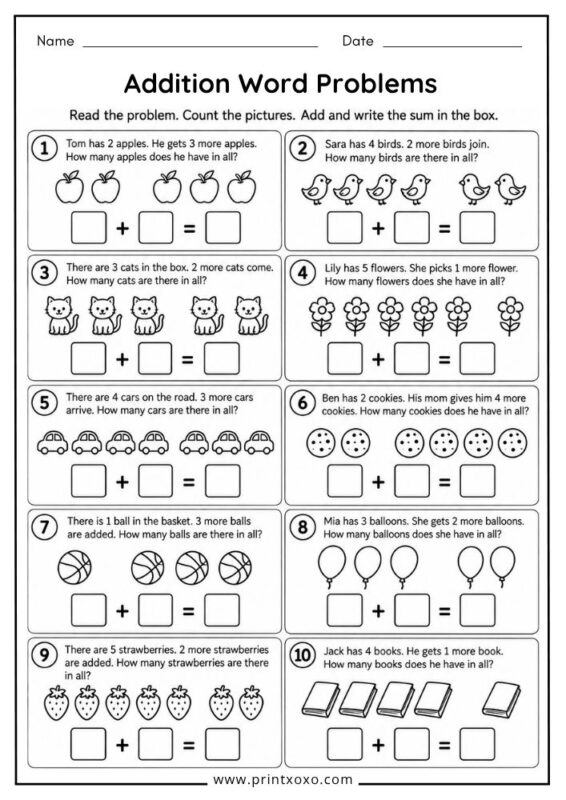
Read each problem, solve the addition, and write the answer.
Addition Worksheets for Preschool and Kindergarten
Once children begin to understand counting, they are ready to notice what happens when another group is added. Maybe there are three blocks on the table and someone puts two more beside them. Maybe a child has four toy animals and gets one more.
These everyday situations are simple examples of addition.
The worksheets above give children a chance to take that idea from something they can see and touch to something they can represent with pictures, numbers, and equations.
What Is Addition?
Addition means putting two or more quantities together to find how many there are altogether.
For young children, it is often easier to understand addition with real objects before working with numbers on a page. If you put two apples next to three more apples, a child can count all five and begin to see what the addition problem represents.
As children become more comfortable with this idea, they can start connecting the groups to an equation.
That progression is important. Children are not just learning that a particular equation has an answer. They are learning what the numbers and symbols actually mean.
Learning Addition With Pictures
Pictures can make early addition much easier to understand.
Instead of starting with an equation alone, children can see two groups of objects. They count the first group, count the second group, and then count the combined group.
The Addition with Pictures and Count and Add worksheets are useful for this type of practice.
These activities are especially helpful when a child is still developing the connection between numbers and quantities.
Practicing Addition Within 5
Working with small numbers gives children a manageable place to start.
Addition within 5 allows children to practice combinations without having too many objects or numbers to keep track of. They can use their fingers, small counters, or pictures if they need additional support.
Once these smaller combinations become familiar, children can gradually work with larger numbers.
Practicing Addition Within 10
After children are comfortable with smaller quantities, addition within 10 gives them a little more room to practice.
Children may already recognize some combinations without counting every object. With continued practice, they can begin to notice common number relationships and become more confident solving simple equations.
The goal is not speed. Understanding the quantities comes first.
Using Ten Frames for Addition
Ten frames are a useful visual tool for early math because they organize quantities in a consistent way.
When children see two groups represented on ten frames, they can count the quantities and think about what happens when those groups are combined.
Ten frames can also help children become familiar with numbers up to 10 and notice how close a quantity is to a full group of ten.
For a child who finds a plain equation difficult to understand, the visual structure of a ten frame can make the same problem easier to see.
Understanding Number Bonds
Number bonds show children that a whole number can be made from smaller parts.
For example, 5 can be made using different pairs of numbers. The same idea can then be extended to 10.
The Number Bonds to 5 and Number Bonds to 10 worksheets give children practice finding the missing part of these combinations.
This type of practice helps children think about the relationship between numbers rather than treating every addition problem as a completely new question.
Make 5 and Make 10
Making 5 and making 10 are closely connected to number bonds.
Children look at one part and think about what number is needed to complete the whole. This encourages them to become familiar with useful combinations instead of relying on counting every time.
For example, once a child knows that 6 and 4 make 10, that relationship can be used again when solving other addition problems.
Finding the Sum
The word sum simply refers to the answer to an addition problem.
The Find the Sum worksheet gives children direct practice with addition equations. This type of practice can be useful once they understand what addition means and are ready for more independent work.
It also gives parents and teachers an easy way to see which basic facts a child knows and which ones may need more practice.
Working With Missing Numbers
A missing-number problem asks children to figure out which number belongs in an incomplete equation.
This requires a little more thinking than simply solving a complete addition problem. Children need to look at the numbers that are already shown and decide what is needed to make the equation correct.
The Missing Addend Addition and Missing Number in Addition worksheets provide practice with this idea.
If a child finds these problems difficult, it can help to return to counters or other objects and physically build the two parts before going back to the worksheet.
Making Addition More Hands-On
Young children often learn best when math is connected to something they can actually do.
You can use blocks, toy cars, buttons, small snacks, or other everyday objects for quick addition practice.
Put a few objects in one group and a few in another. Ask your child to count both groups and then count how many there are altogether.
Dice can also make a simple addition activity more interesting. Children can count the dots on two dice and combine the quantities, just as they do on the Addition with Dice worksheet.
These small activities do not need to become formal lessons. A few minutes here and there can give children useful practice.
Using Addition Worksheets at Home
There is no need to print and complete all of the worksheets in one sitting.
Choose a page that matches what your child is currently learning. A child who is just beginning may do better with pictures and counting, while a child who already understands basic addition may be ready for number bonds or missing numbers.
You can also keep a few pages aside and return to them later for review.
Short, regular practice is often easier for young children than a long worksheet session.
Using Addition Worksheets in the Classroom
These worksheets can fit into a variety of kindergarten and early elementary math routines.
A teacher might introduce addition with counters or classroom objects and then use a worksheet for independent practice. Picture addition and ten frames can work well when children need a visual model, while number bonds and missing numbers can provide additional practice once the basic idea is understood.
The pages can also be used for:
- Math centers
- Small-group practice
- Independent work
- Morning math
- Review activities
- Take-home practice
Teachers can choose different worksheets for different learners instead of expecting every child to work at exactly the same level.
Addition Worksheets for Homeschool
For homeschool families, printable worksheets can be used alongside hands-on math activities.
You might spend a few minutes working with counters, talk through an addition example, and then let your child complete one worksheet independently.
If your child needs more practice, you can use another worksheet with the same general skill but a different format. If the concept is already clear, move on instead of requiring unnecessary repetition.
The collection includes enough variety to revisit addition without using the exact same type of activity every time.
When Should Children Learn Addition?
Children begin developing addition concepts well before they can solve written equations.
Preschoolers may naturally combine groups while playing or counting objects. Kindergarten children typically begin working with addition in a more structured way, including simple equations and number relationships.
There is no need to rush the process.
A child who can confidently count two groups and explain how many there are altogether is already building an important foundation for written addition.
How Can I Help a Child Who Struggles With Addition?
If an addition equation feels too abstract, take it back to something concrete.
Use small objects and physically create the two groups. Let the child count them separately and then count them together.
You can also draw simple pictures to represent the numbers.
Once the child understands the quantities, show how those groups are represented by the numbers in the equation.
This can be much more helpful than simply asking the child to repeat the problem several times.
Printing the Addition Worksheets
These worksheets are designed to be simple and printer-friendly for use at home or in the classroom.
The worksheets are available for US Letter-size paper, which is convenient for typical printing in the United States. A4 versions can also be used when that paper size is preferred.
You can print individual worksheets based on the skill your child is practicing rather than printing the entire collection at once.
Frequently Asked Questions
What are addition worksheets?
Addition worksheets give children structured practice with putting quantities together and solving addition problems. They can use pictures, numbers, ten frames, number bonds, dice, or simple word problems.
Are these addition worksheets good for kindergarten?
Yes. The collection includes several activities suitable for kindergarten children, including addition within 10, ten frame addition, number bonds, missing numbers, dice addition, and simple word problems.
Can preschoolers use addition worksheets?
Yes. Preschoolers who are beginning to explore addition can start with visual activities such as counting and combining groups. More advanced equation-based pages can be introduced as they become ready.
What should a child know before learning addition?
Children benefit from being comfortable with counting and recognizing numbers and quantities. Being able to count small groups of objects is particularly helpful when first introducing addition.
What does addition within 10 mean?
Addition within 10 means solving addition problems where the total is 10 or less. It gives young children a manageable range for practicing basic addition.
What are number bonds?
Number bonds show how a whole number can be made from smaller parts. For example, children can learn different combinations that make 5 or 10.
How can I practice addition without worksheets?
You can use blocks, toys, buttons, snacks, or other small objects. Create two groups, combine them, and ask the child to count how many there are altogether.
Can I print these worksheets on US Letter paper?
Yes. The worksheets include US Letter-size versions for convenient printing at home or in the classroom. A4 versions are also available.
Final Thoughts
Addition does not have to begin with a page full of equations. For young children, it can start with two groups of blocks, a handful of toys, or a few pictures on a worksheet.
As children move from counting objects to working with numbers, different types of practice can help them see addition from more than one angle.
These free printable addition worksheets give preschool and kindergarten children opportunities to count, combine, find sums, work with number bonds, complete missing numbers, and solve simple addition situations.
Choose the pages that fit your child’s current level, keep practice short and manageable, and give children plenty of opportunities to explain how they found their answers. That understanding is what makes the early addition skills stick.