

Blog
How to Teach Counting to Preschoolers (Without Making It Feel Like School)

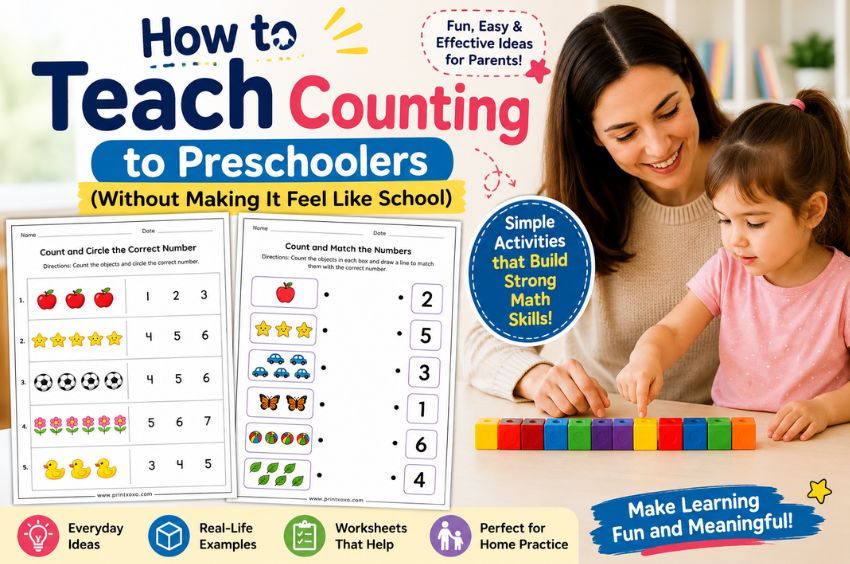
Most kids learn to say numbers long before they actually understand them.
A child may happily count from 1 to 10 while sitting in the car. Then a few minutes later, you place five toy blocks on the floor and ask how many there are. Suddenly the answer becomes seven, nine, or sometimes even twelve.
If you’ve seen this happen, you’re not alone.
Many parents think their child is struggling with counting when the real issue is something else. The child knows the number words. They just haven’t connected those words to real objects yet.
That’s completely normal.
In fact, learning to count is usually a step-by-step process. Children first learn number names. Then they learn to match numbers with quantities. After that, they begin understanding that numbers actually represent how many things they see.
The good news is that you don’t need expensive learning programs or long lessons to teach counting. Most children learn best through simple everyday activities.
Why Counting Is Harder Than It Looks
Adults often forget how complicated counting actually is.
When we count five apples, our brain does several things automatically. We recognize the apples, count each one only once, keep track of the total, and understand that the final number represents the entire group.
For a preschooler, that’s a lot to process.
This is why a child might count like this:
“1, 2, 3, 4, 5, 6”
while pointing at only four objects.
They’re not being careless. They’re still learning how counting works.
That’s why patience matters so much during this stage.
Start With Real Objects, Not Worksheets
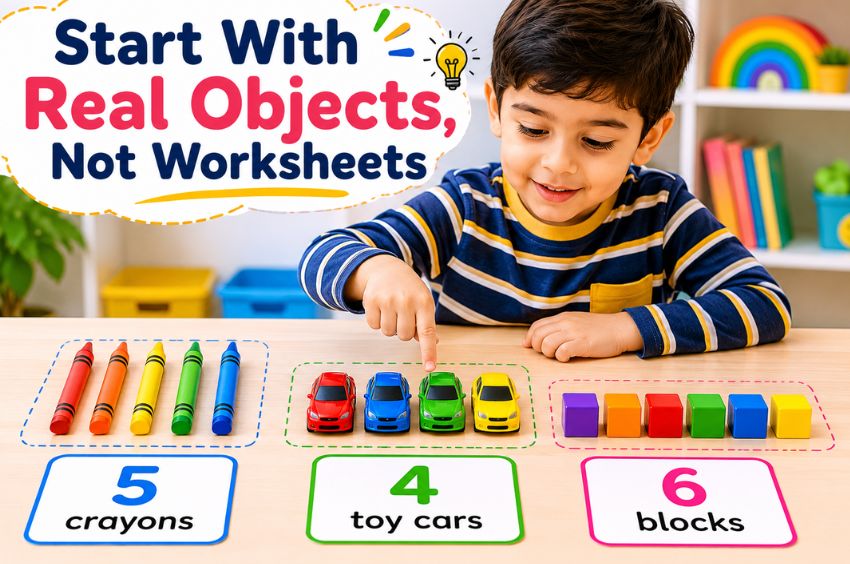
Many parents immediately search for worksheets when teaching numbers.
Worksheets can be helpful, but they shouldn’t be the starting point.
Real objects usually work better at first.
Try counting:
- Toy cars
- Building blocks
- Crayons
- Apples
- Cookies
- Books
- Stuffed animals
- Small snacks
Place a few objects in front of your child.
Then slowly count them together.
Touch each object while saying the number.
This simple habit teaches one of the most important counting skills: one object gets one number.
It sounds obvious to adults. For young children, it’s a major breakthrough.
Make Counting Part of Everyday Life
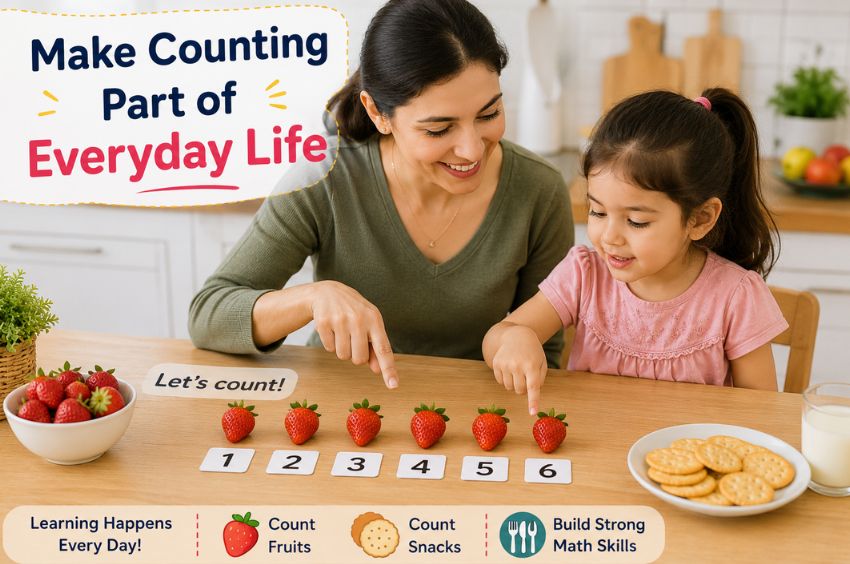
One mistake many parents make is treating counting like a school subject.
Kids don’t always learn best that way.
Instead of creating formal lessons, try adding counting to activities you’re already doing.
At breakfast, ask:
“How many strawberries are on your plate?”
While cleaning toys:
“Can you count how many cars need to go back in the box?”
At the grocery store:
“Let’s put five bananas in the cart.”
During a walk:
“How many birds can you see?”
These small moments don’t feel like studying. That’s exactly why they work so well.
Children often learn faster when they think they’re playing.
Focus on Understanding, Not Memorization
Many children can memorize number sequences surprisingly quickly.
A child may proudly count to twenty.
That sounds impressive.
But if they can’t accurately count five objects, then the bigger numbers don’t mean much yet.
A stronger goal is helping children understand what numbers represent.
For example:
If a child counts five blocks, they should understand that the answer is five because there are five blocks in the group.
That connection between numbers and quantity is what really matters.
Everything else builds on that skill.
Don’t Rush Past Numbers 1–10
Parents sometimes worry that their child is “behind” because another child can count higher.
Try not to compare.
The most important early counting skills happen between 1 and 10.
When children truly understand these numbers, they develop a much stronger foundation for future math.
Instead of rushing ahead, focus on:
- Counting groups accurately
- Recognizing numbers
- Matching numbers to quantities
- Understanding number order
- Writing numbers correctly
These skills matter more than simply counting to larger numbers.
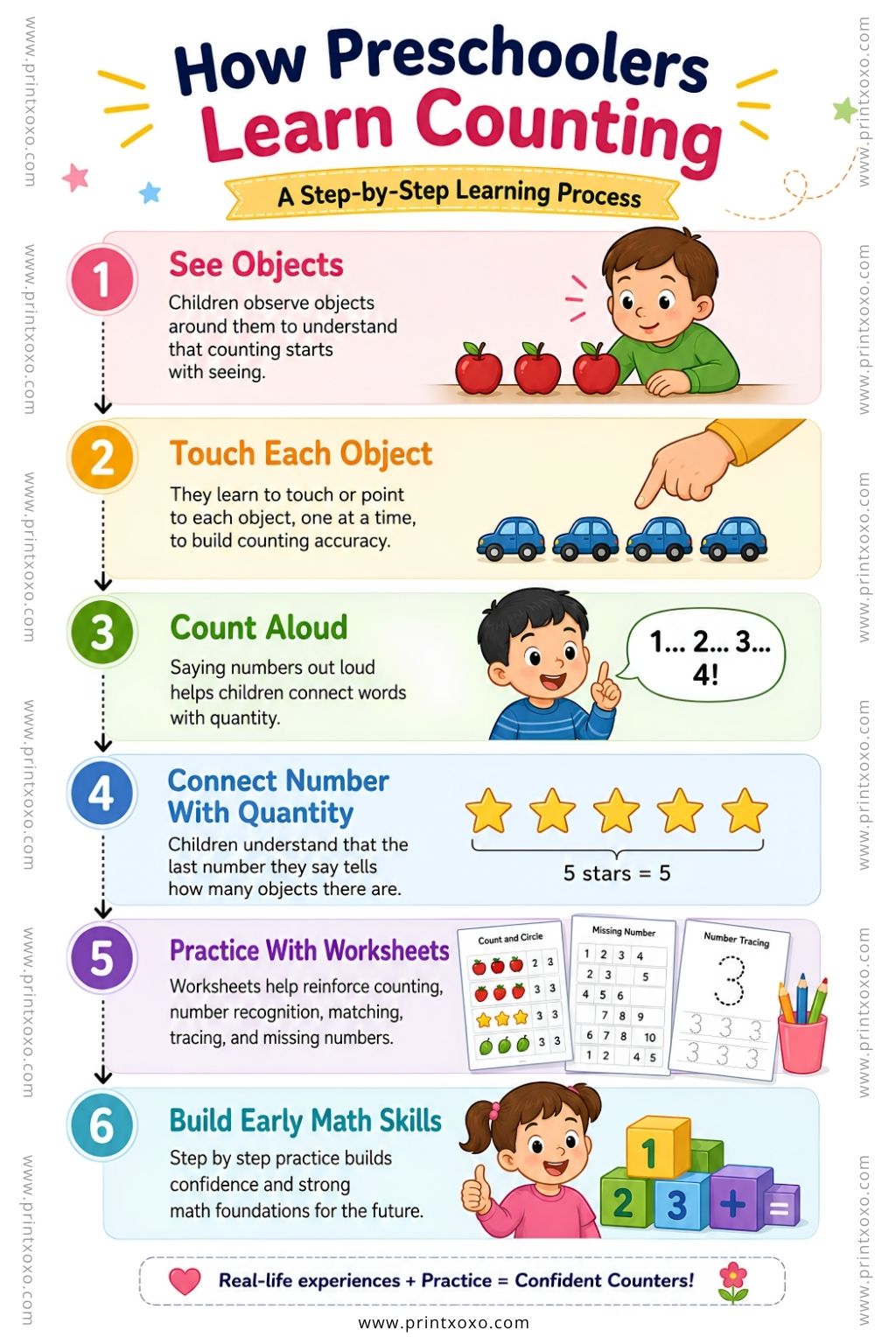
Before children become confident counters, they usually move through several important learning stages. This simple infographic shows how counting skills develop over time.
When Printable Worksheets Start Helping
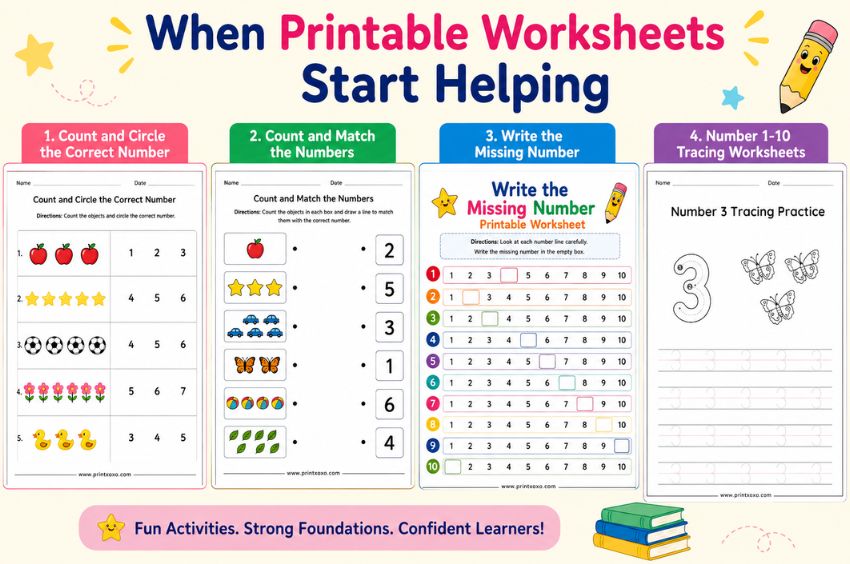
Once children become comfortable counting real objects, worksheets can provide extra practice.
This is where many parents see noticeable improvement.
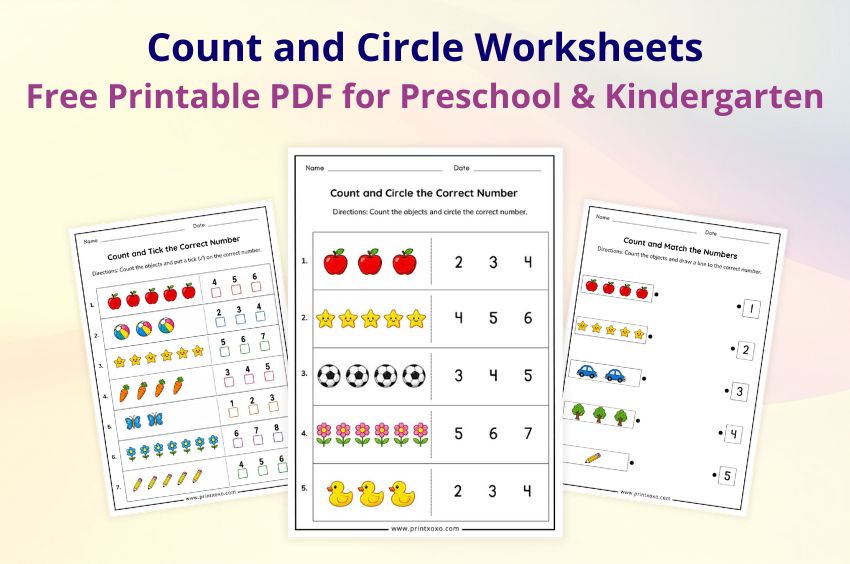
For example, activities that require children to count objects and choose an answer help reinforce number recognition and quantity at the same time.
Our Count and Circle Worksheets are a good example:
Children count the objects, look at the answer choices, and select the correct number. It’s simple, but it encourages them to slow down and think carefully.
Some children have the opposite problem.
They can count objects correctly but struggle to recognize written numbers.
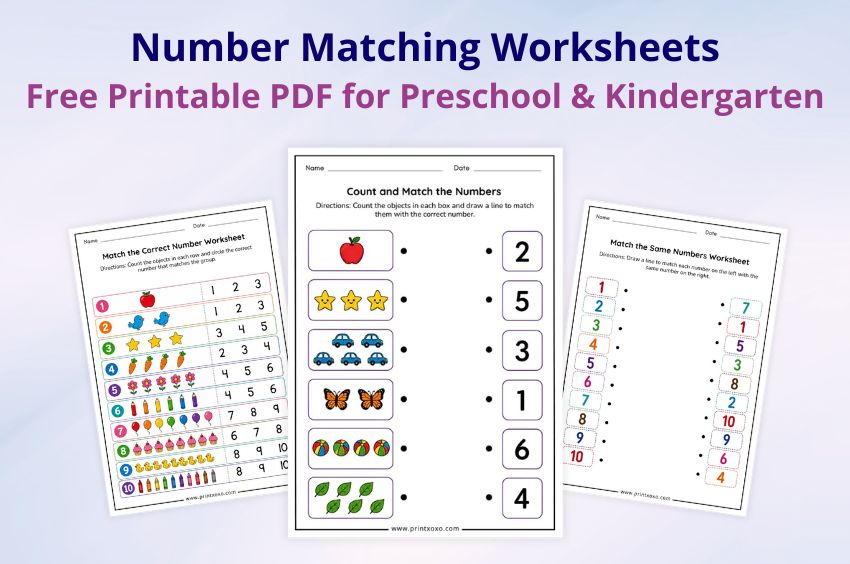
In those situations, Number Matching Worksheets can be helpful:
Matching activities encourage children to connect number symbols with actual quantities. That extra practice often makes a big difference.
A Simple Counting Game That Works Surprisingly Well
One activity many parents accidentally discover is what I like to call the “Grab and Count” game.
You don’t need any special materials.
Take a bowl and fill it with small objects such as blocks, toy animals, or large buttons.
Ask your child to grab a handful.
Now count together.
Touch each object while counting.
After you finish, ask:
“Can you find the same number again?”
Most children enjoy repeating the challenge because it feels more like a game than a lesson.
At the same time, they’re practicing counting, observation, and number recognition without realizing it.
Why Some Children Count Correctly One Day and Struggle the Next
Parents often find this confusing.
One day their child counts perfectly.
The next day they make several mistakes.
This is actually very common.
Young children are still developing attention, memory, and concentration skills.
A child who is tired, distracted, excited, or simply having an off day may count differently than they did yesterday.
Progress is rarely a straight line.
Most children move forward, make mistakes, improve again, and gradually become more consistent over time.
That’s a normal part of learning.
Common Counting Mistakes Parents Make
Most counting mistakes don’t happen because children aren’t capable of learning.
They happen because adults accidentally make the process harder than it needs to be.
Correcting Every Mistake Immediately
When a child makes a mistake, our first instinct is usually to jump in.
“That’s wrong.”
“Try again.”
“You missed one.”
Sometimes that’s necessary. Most of the time, it isn’t.
Give children a few seconds to think. Many will catch their own mistakes if they get the chance.
Self-correction is a powerful learning tool.
Turning Counting Into Homework
Some children love worksheets.
Others don’t.
If every counting activity feels like work, motivation drops quickly.
Mix things up.
Count toys one day. Count snacks the next day. Use worksheets when they make sense, but don’t rely on them for everything.
Practicing for Too Long
Young children have short attention spans.
Ten focused minutes usually beats thirty minutes of frustration.
Many parents are surprised by how much progress happens through short daily practice sessions.
Consistency matters more than duration.
Comparing Children
Every preschooler develops at a different pace.
One child may count confidently at three years old.
Another may need extra time.
Both situations can be completely normal.
The goal isn’t to keep up with another child. The goal is steady progress.
How Missing Number Activities Help
Once children become comfortable counting objects, they can start working on number sequences.
This is where many parents notice another challenge.
A child may know numbers 1 through 10 but still struggle with a sequence like:
1, 2, __, 4, 5
This skill is important because it teaches children how numbers relate to each other.
Instead of memorizing numbers individually, they begin seeing patterns.
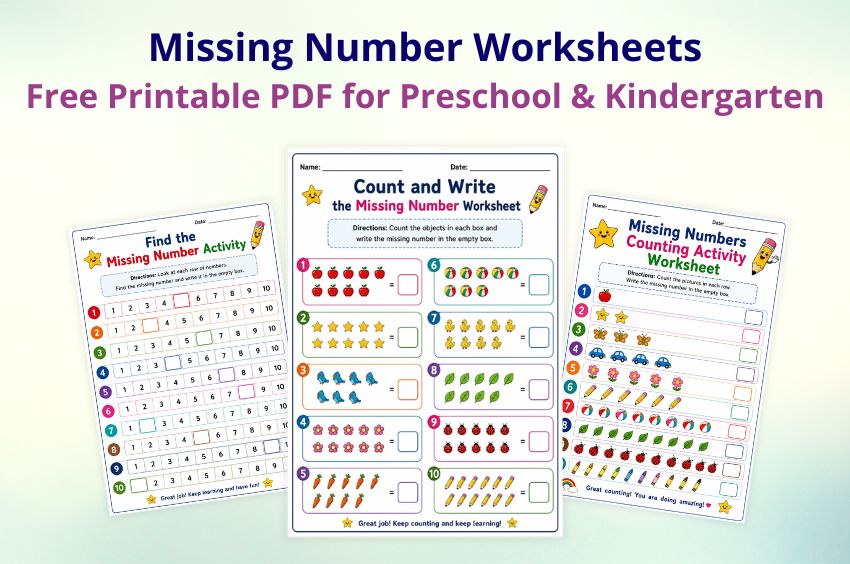
That’s one reason Missing Number Worksheets are so useful:
These activities help children understand number order while strengthening counting skills at the same time.
For many kids, missing number exercises feel more like puzzles than math practice.
That’s a good thing.
Children often learn best when learning feels fun.
What About Number Writing?
Counting and writing are different skills.
Some children can count ten objects perfectly but struggle to write the number ten.
Again, that’s completely normal.
Writing numbers requires:
- Pencil control
- Hand strength
- Fine motor skills
- Number recognition
These skills develop over time.
The important thing is giving children regular opportunities to practice.
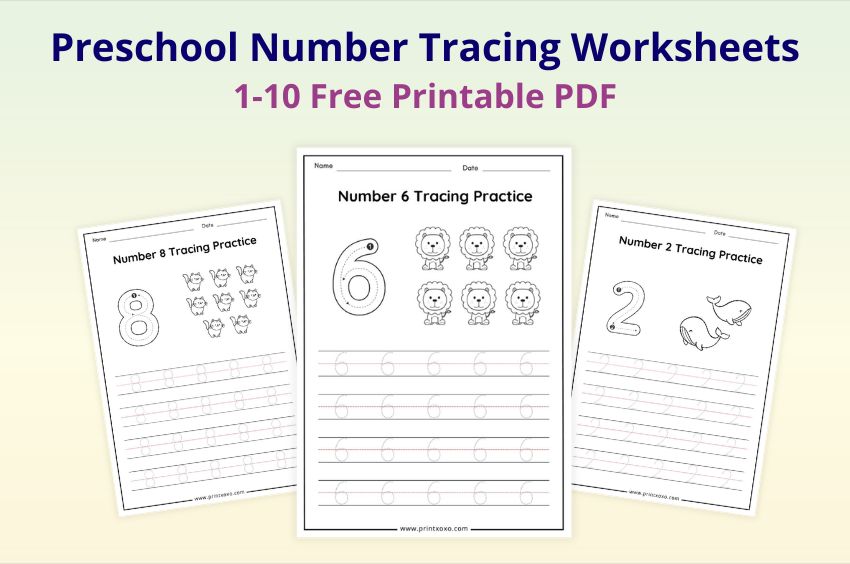
If your child is still learning how to form numbers correctly, Numbers 1–10 Tracing Worksheets can help:
Tracing activities help children become more comfortable with number shapes while improving handwriting skills.
A few minutes of tracing practice each day can go a long way.
Signs Your Child Is Making Progress
Parents sometimes expect dramatic improvements.
In reality, progress often shows up in small ways.
Look for things like:
- Counting objects more accurately
- Making fewer mistakes
- Recognizing numbers faster
- Correcting mistakes without help
- Showing interest in counting activities
- Using numbers during everyday conversations
These small wins matter.
In fact, they often appear long before perfect counting does.
What If Your Child Doesn’t Like Counting?
This happens more often than people think.
Some children naturally enjoy numbers.
Others would rather do almost anything else.
If counting activities aren’t working, change the approach.
Instead of counting blocks, try:
- Toy dinosaurs
- Cars
- Action figures
- Stuffed animals
- Stickers
- Favorite snacks
Children engage more when activities involve something they already love.
You can also make counting part of movement.
Count steps while climbing stairs.
Count jumps.
Count claps.
Count throws during a game.
Learning doesn’t always need to happen at a table.
The Goal Isn’t Perfect Counting
Many parents focus on getting every answer right.
That’s understandable.
But early counting isn’t about perfection.
It’s about building understanding.
A child who makes mistakes today may suddenly improve a few weeks later.
Young learners often absorb information quietly before showing visible progress.
That’s why patience is so important.
The goal is not to create a math expert overnight.
The goal is helping children understand that numbers have meaning.
Once that understanding develops, future math skills become much easier.
Related Worksheets
If you’re looking for extra counting practice, these printable resources may help:
Count and Circle Worksheets
Number Matching Worksheets
Missing Number Worksheets
Numbers 1–10 Tracing Worksheets
Final Thoughts
Teaching counting doesn’t require expensive programs, complicated lesson plans, or hours of daily practice.
Most children learn best through simple experiences repeated over time.
Count toys.
Count snacks.
Count steps.
Count anything that captures your child’s attention.
Use printable activities when they add value. Keep learning fun. Celebrate small improvements.
And remember, counting is a skill, not a race.
Children don’t need to learn everything today.
They simply need opportunities to practice, explore, and build confidence one number at a time.