

Blog
Body Parts Worksheets | Free Printable Activities for Preschool & Kindergarten

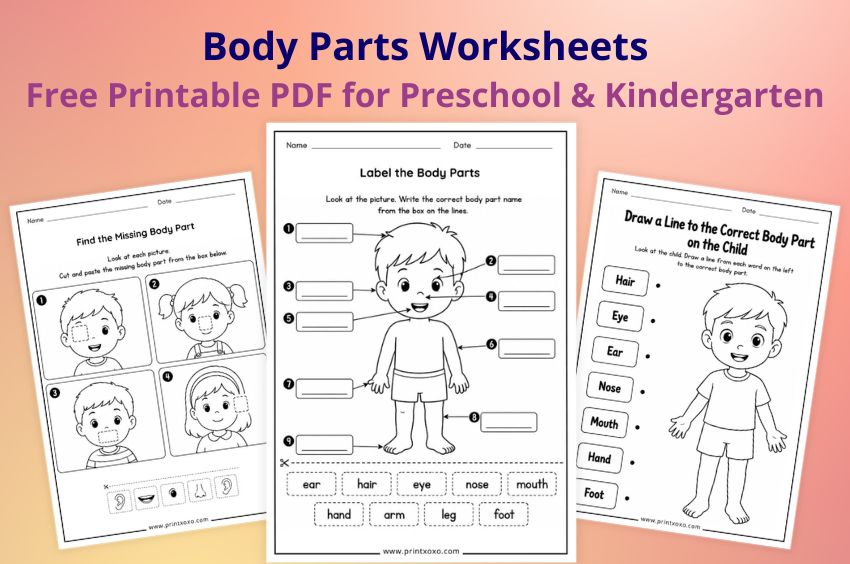
Children are naturally curious about their own bodies. They point to their eyes, touch their nose, wave their hands, and ask simple questions every day. These free printable Body Parts Worksheets help preschool and kindergarten children learn body part names through matching, labeling, cut-and-paste, and other fun activities. Download the worksheets below and enjoy learning together at home or in the classroom.
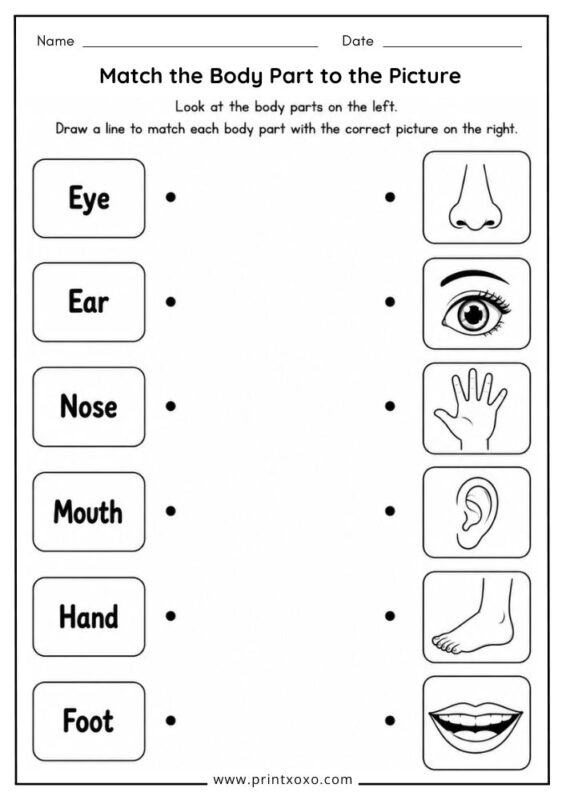
Learn body part names by matching each word to the correct picture. A fun printable activity for preschool and kindergarten learners.
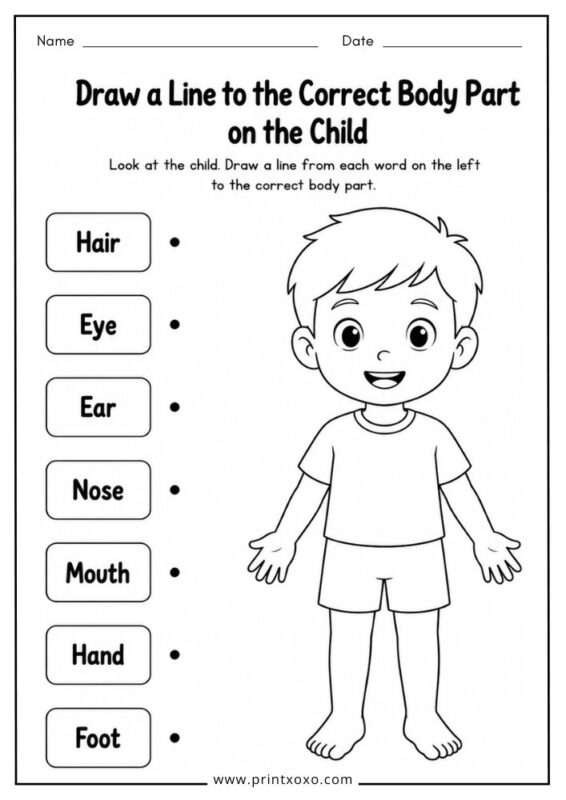
Practice identifying body parts by drawing lines to the correct place. Great for preschool and kindergarten learning.
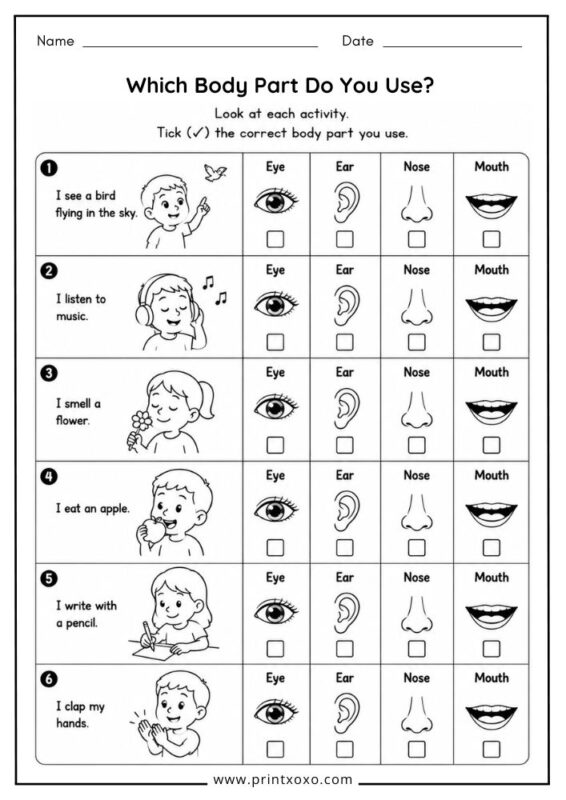
Choose the correct body part used for each daily activity. A fun printable worksheet for young learners.
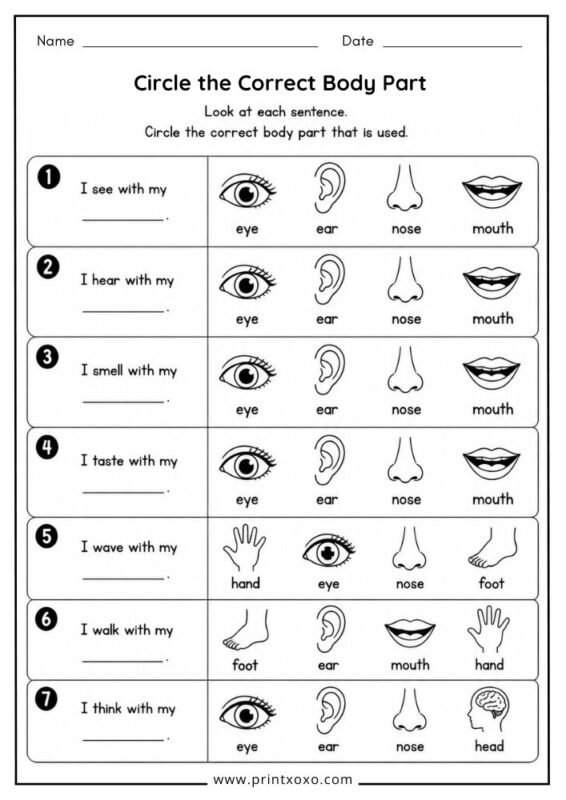
Read each sentence and circle the correct body part. Perfect for preschool and kindergarten practice.
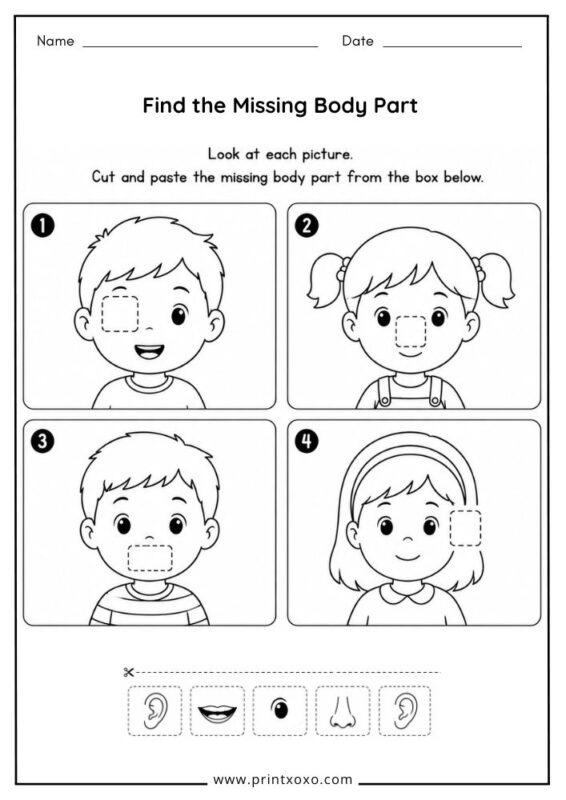
Find the missing body part and complete each picture. A fun cut and paste activity for young learners.
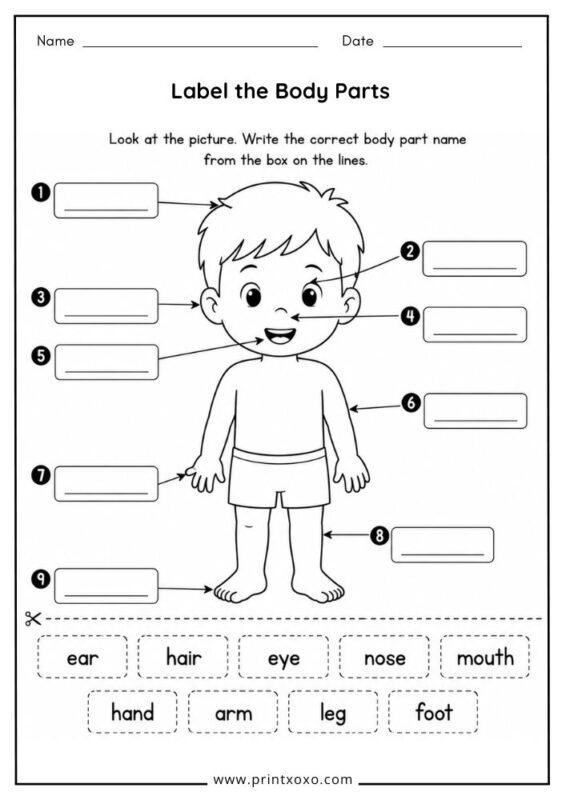
Identify and label the correct body parts using the word bank. Perfect for preschool and kindergarten learners.
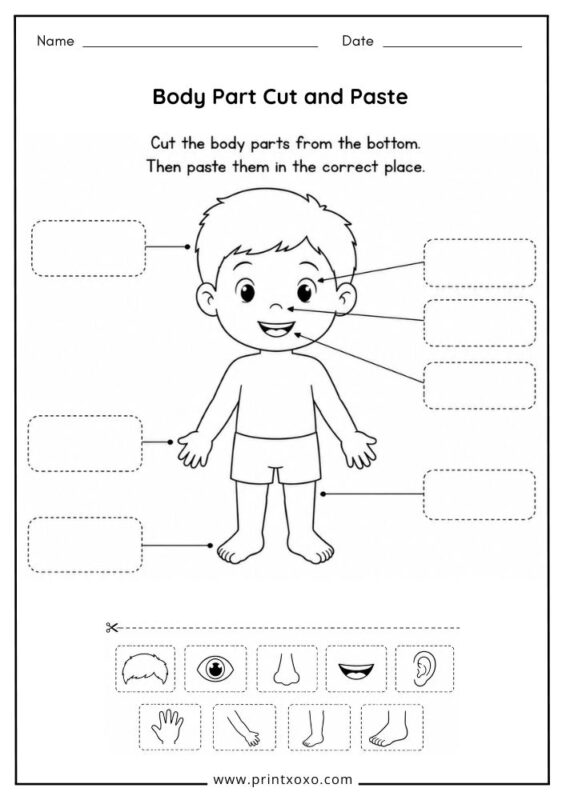
Cut and paste each body part into the correct place. A hands-on printable activity for preschool and kindergarten.
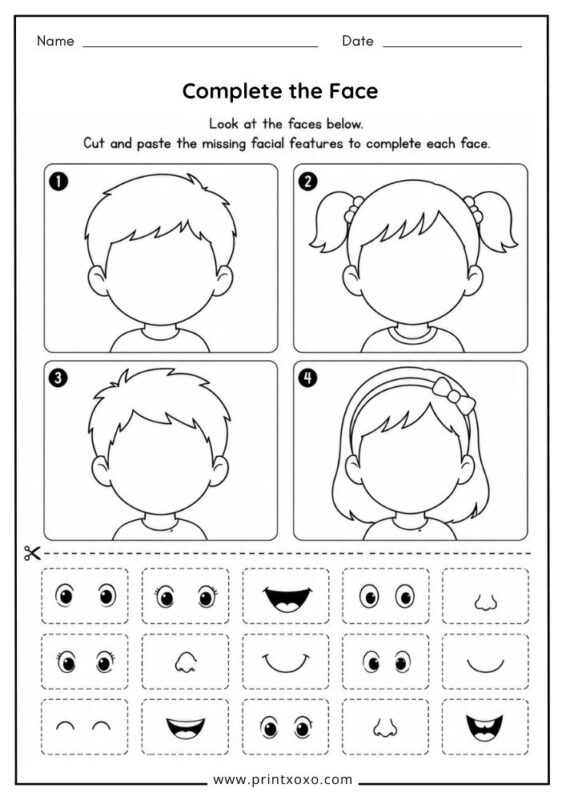
Complete each face by adding the missing facial features. A fun cut and paste activity for preschool and kindergarten.
Why Learning Body Parts Is an Important Early Childhood Skill
One of the first science topics introduced in preschool isn’t about planets, weather, or even animals. It starts much closer to home—our own body.
Before children can understand how their bodies work, they first need to recognize the different body parts they use every single day. Long before they can read or write, they’re already looking with their eyes, listening with their ears, waving their hands, running with their feet, and smiling with their mouths. These everyday experiences make body parts one of the easiest and most meaningful science topics to introduce during the early years.
As an early childhood educator, I’ve noticed that children rarely learn body parts by memorizing a list of words. They learn because those words become part of everyday conversations.
“Can you touch your nose?”
“Raise your hand.”
“Close your eyes.”
“Stand on your feet.”
These simple directions are repeated hundreds of times throughout childhood. Over time, children naturally begin connecting each word with the correct body part.
That is why worksheets should never be the first step.
Worksheets work best after children have already explored these ideas through movement, conversations, songs, and everyday routines. They reinforce learning rather than introducing it for the very first time.
Why Children Learn Better Through Movement
If you’ve ever watched a group of preschoolers, you’ll notice something almost immediately—they rarely sit still for long.
Young children are active learners.
They don’t just listen.
They move.
They point.
They touch.
They explore.
This is exactly why movement should always be part of teaching body parts.
For example, instead of showing a picture of an ear and saying, “This is an ear,” try asking,
“Can you touch your ears?”
Immediately, every child becomes involved.
The lesson changes from passive listening to active learning.
The same approach works with almost every body part.
- Wiggle your fingers.
- Stamp your feet.
- Blink your eyes.
- Clap your hands.
- Point to your nose.
- Smile with your mouth.
These simple actions may look like games, but they’re actually helping children build stronger connections between vocabulary and real-life experiences.
Once children complete these activities, worksheets suddenly become much easier because the learning has already started.
Learning Body Parts Builds More Than Vocabulary
Many adults assume body parts worksheets are simply about teaching children new words.
In reality, much more is happening.
Every activity supports several important developmental skills at the same time.
When children match a body part to its picture, they practice visual discrimination and observation.
When they draw lines to the correct body part, they strengthen hand-eye coordination and pencil control.
When they cut and paste missing body parts, they develop fine motor skills that will later help with handwriting.
When they answer questions about which body part they use, they’re practicing logical thinking instead of memorizing information.
This is one reason preschool teachers often revisit body parts throughout the school year. Each activity reinforces multiple skills while keeping children engaged.
What Children Will Learn From These Worksheets
This printable worksheet collection was created to give children several different ways to practice the same concept without repeating the same activity over and over again.
Each worksheet introduces a slightly different challenge, allowing children to build confidence step by step.
As they work through the activities, children will practice:
- Recognizing common body parts
- Matching words with pictures
- Identifying body parts on a child
- Understanding how different body parts are used
- Following simple directions
- Improving observation skills
- Building fine motor control
- Developing early science vocabulary
- Strengthening logical thinking
- Completing independent learning activities
Instead of relying on a single worksheet format, children experience matching, line drawing, labeling, problem-solving, and hands-on cut-and-paste activities. This variety keeps learning interesting while reinforcing the same important topic.
Start With the Body Parts Children Already Know
One mistake I sometimes see is introducing too many body parts at once.
Children don’t need to learn twenty different body parts during their first lesson.
In fact, doing too much too quickly often creates unnecessary confusion.
A better approach is to begin with the body parts children use and notice every day.
Face First
Most preschoolers already recognize:
- Eyes
- Ears
- Nose
- Mouth
These are easy to practice because children use them constantly throughout the day.
Parents can reinforce learning with simple questions like:
- Which body part helps you see?
- Which body part helps you hear music?
- Which body part helps you smell a flower?
- Which body part helps you taste your favorite snack?
Children usually answer these questions with excitement because they can relate them to their own experiences.
Add Arms, Hands, Legs, and Feet Next
Once children are comfortable identifying facial features, it’s time to introduce larger body parts.
These include:
- Arm
- Hand
- Leg
- Foot
Again, movement makes learning much easier.
Ask children to:
- Wave their hand.
- Stretch their arms.
- Stamp their feet.
- Jump using both legs.
Instead of memorizing words from a worksheet, children begin connecting body part names with real actions.
This simple progression feels natural because it follows the way young children already experience their own bodies.
Every Worksheet Has a Different Learning Purpose
At first glance, these worksheets may all look similar.
However, each activity develops a different skill.
For example, matching activities strengthen recognition.
Line-drawing worksheets improve observation and concentration.
Question-based worksheets encourage reasoning.
Cut-and-paste activities develop fine motor skills.
Labeling worksheets reinforce vocabulary.
By changing the activity while keeping the topic the same, children stay interested without feeling like they’re doing the same worksheet repeatedly.
This approach is commonly used in early childhood classrooms because it helps children build understanding through repetition without creating boredom.
How to Make Body Parts Practice More Meaningful
Printable worksheets are a wonderful learning tool, but they work best when they’re part of a bigger learning experience.
Before giving children a worksheet, spend a few minutes talking, moving, and playing together. Young children remember information much better when they can connect it to something they’ve already experienced.
For example, before starting the Match the Body Part to the Picture worksheet, ask children to point to different body parts on themselves.
You might say:
- Touch your head.
- Point to your ears.
- Close your eyes.
- Wiggle your fingers.
- Stamp your feet.
These simple activities only take a few minutes, but they prepare children to complete the worksheet with much more confidence.
As an early childhood teacher, I’ve often noticed that children who move first usually understand the worksheet much faster than children who only look at pictures.
Turn Everyday Moments Into Learning Opportunities
One of the biggest advantages of teaching body parts is that you don’t need a classroom or special teaching materials.
Learning happens naturally throughout the day.
While getting dressed, ask:
“Which body part does your sock go on?”
During bath time:
“Can you wash your elbows?”
While brushing teeth:
“Open your mouth nice and wide.”
During story time:
“Which body part helps you see the pictures?”
These everyday conversations introduce body part vocabulary without making children feel like they’re studying.
Many parents don’t realize how much learning can happen during ordinary routines.
In fact, some of the strongest vocabulary development happens during these short, natural conversations.
Simple Games That Reinforce Body Parts
Children learn best when lessons feel like games instead of tests.
You don’t need expensive teaching resources to make body parts practice enjoyable.
Simon Says
“Simon says touch your nose.”
“Simon says raise your hand.”
“Simon says stamp your feet.”
Besides teaching body parts, this game also improves listening skills and attention.
Mirror Play
Stand in front of a mirror with your child.
Point to different body parts and ask them to copy your actions.
Children love seeing themselves while learning, making this activity both educational and entertaining.
Body Part Songs
Songs with actions help children remember vocabulary naturally.
When children sing while moving, they build stronger connections between words and actions than they do through memorization alone.
Action Challenges
Turn learning into a quick challenge.
Ask questions like:
- Which body part helps you clap?
- Which body part helps you smell cookies?
- Which body part helps you kick a ball?
Children enjoy answering because they already know the actions from their daily lives.
Common Mistakes Parents Often Make
Teaching body parts may sound simple, but a few common mistakes can make learning harder than it needs to be.
Teaching Too Many Words at Once
Children don’t need to learn every body part in one lesson.
Start with familiar body parts such as:
- Eyes
- Ears
- Nose
- Mouth
- Hands
- Feet
Once children know these confidently, slowly introduce new vocabulary like elbows, shoulders, knees, fingers, and toes.
Small steps almost always produce better results than rushing.
Correcting Every Small Mistake
Young children are still learning.
If they accidentally point to the wrong body part, avoid turning it into a test.
Instead, gently model the correct answer and encourage them to try again.
Confidence grows much faster when children feel safe making mistakes.
Depending Only on Worksheets
Worksheets are excellent practice tools, but they shouldn’t become the entire lesson.
Children also need:
- Movement
- Songs
- Conversations
- Games
- Daily routines
- Hands-on experiences
When these activities work together, learning becomes much more meaningful.
Helping Children Become Independent Learners
One thing I appreciate about body parts activities is that children become more independent as they progress.
At first, they may need help reading directions or understanding what to do.
After completing a few activities, something interesting begins to happen.
Children start recognizing body parts on their own.
They answer questions more confidently.
They complete matching activities without asking for help.
They begin using body part names naturally during conversations.
That confidence often carries over into other preschool subjects as well.
Instead of waiting for instructions, children become active learners who enjoy discovering new things.
Who Can Use These Body Parts Worksheets?
These printable activities are suitable for a variety of learning environments.
They work well for:
- Preschool classrooms
- Pre-K learning centers
- Kindergarten lessons
- Homeschool families
- Childcare programs
- Early intervention activities
- Extra practice at home
Teachers can use them during science lessons, morning work, independent centers, or small-group instruction.
Parents often use them as short learning activities that fit easily into everyday routines.
Frequently Asked Questions
Are these Body Parts Worksheets suitable for preschool children?
Yes. Most activities are designed for preschool and kindergarten learners. Younger children may need a little guidance, while older preschoolers can complete many worksheets independently.
Can I use these worksheets in my classroom?
Absolutely. They’re suitable for classroom lessons, learning centers, homework, independent practice, and homeschool activities.
Why are there different types of worksheets instead of repeating the same activity?
Children learn best when they practice one concept in different ways.
Matching, labeling, cut-and-paste, line drawing, and problem-solving activities all strengthen different skills while reinforcing the same topic.
What should children learn after body parts?
Body parts provide an excellent foundation for other early science topics.
After children become familiar with common body parts, they’re usually ready to explore topics such as Five Senses, Living and Non-Living Things, and Land, Water and Air Animals.
These subjects naturally build on the observation skills children develop while learning about their own bodies.
Final Thoughts
Learning body parts is much more than memorizing a few simple words. It’s one of the first steps toward helping children understand themselves, communicate clearly, follow instructions, and explore the world with confidence.
These free printable Body Parts Worksheets combine matching, labeling, observation, problem-solving, and hands-on activities to create a complete learning experience for preschool and kindergarten children. Each worksheet introduces a different challenge, allowing children to practice the same concept in new and engaging ways.
Whether you’re teaching in a classroom, homeschooling, or simply spending a few minutes learning together at home, these printable activities make it easy to turn everyday moments into meaningful learning experiences.
If your child enjoyed these worksheets, you may also like our Five Senses Worksheets, Living and Non-Living Things Worksheets, and Land, Water and Air Animals Worksheets. Together, these resources help build a strong foundation for early science learning while keeping children curious, engaged, and excited to learn.